
Last updated: November 24, 2026
Check your credit score in your banking app, then on a free credit website, and you’ll often see two different numbers. Neither is necessarily wrong. Most likely, one is a FICO Score and the other a VantageScore: two competing models that read your credit reports in slightly different ways. Here’s how they compare, why the numbers differ and which one matters when you apply for a loan.
The short version
| FICO Score | VantageScore | |
|---|---|---|
| Created by | Fair Isaac Corporation (FICO), 1989 | Equifax, Experian and TransUnion, 2006 |
| Score range (main versions) | 300 to 850 | 300 to 850 |
| “Good” starts at | 670 | 661 |
| Minimum credit history | At least one account open six months and one reported in the last six months | Can score thinner files with less history |
| Common versions | FICO 8, 9, 10 and 10T; older versions for mortgages | VantageScore 3.0 and 4.0 |
| Where you’ll see it | Many banks and card issuers; most lending decisions | Many free credit apps and websites |
Why your scores don’t match
Both models use the information in your credit reports from Equifax, Experian and TransUnion. Your scores can still differ for several reasons:
- Different formulas. Each model weighs things like late payments, new accounts and balances in its own way.
- Different versions. FICO Score 8 and FICO Score 10 can give different results from the same report, and the same goes for VantageScore 3.0 and 4.0.
- Different bureaus. Not every lender reports to all three credit bureaus, so each report can hold slightly different information.
- Timing. A payment may appear at one bureau a few days before another.
A gap of a few points is normal. A large, sudden difference is a good reason to check your credit reports for errors.
Score ranges side by side
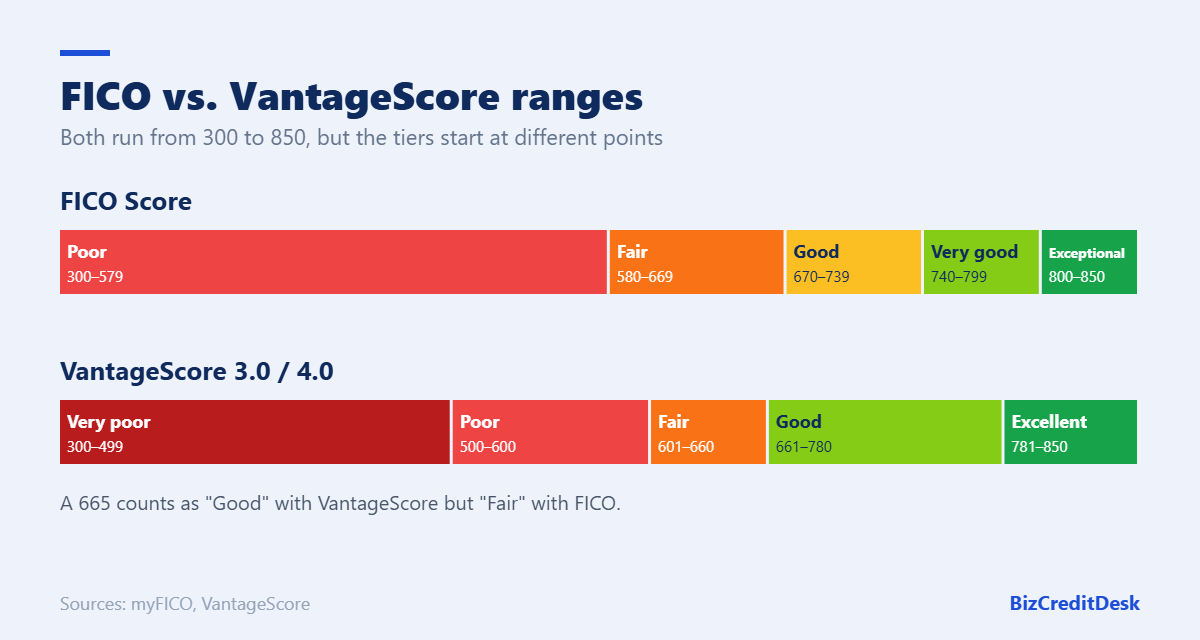
FICO Score: Exceptional 800 to 850, Very good 740 to 799, Good 670 to 739, Fair 580 to 669, Poor 300 to 579.
VantageScore 3.0 and 4.0: Excellent 781 to 850, Good 661 to 780, Fair 601 to 660, Poor 500 to 600, Very poor 300 to 499.
So the same number can land in different tiers. A 665, for example, counts as good with VantageScore but only fair with FICO.
Which score do lenders use?
FICO says its scores are used by 90% of top U.S. lenders, so a FICO Score is a safe bet for most loan and credit card applications. Still, each lender chooses its own model and version, and some use VantageScore or their own internal scoring.
Mortgages have their own rules. Lenders have long used older FICO versions for home loans, and in 2025 the Federal Housing Finance Agency announced that lenders could also use VantageScore 4.0 for loans sold to Fannie Mae and Freddie Mac.
When you apply, it’s fair to ask the lender which score and which bureau it checks. For personal loans specifically, see what credit score you need for a personal loan.
How to improve both scores at once
You don’t need a separate plan for each model. They reward the same habits:
- Pay every bill on time. Payment history is the biggest factor in both models.
- Keep card balances low. See our guide to the 30% credit utilization rule.
- Limit new applications. Learn the difference between hard and soft credit inquiries.
- Keep older accounts open when it makes sense, since the age of your credit matters.
For a deeper look at what goes into the number, read how credit scores are calculated.
Key takeaways
- FICO and VantageScore are competing credit scoring models, and both use a 300 to 850 range.
- Their tiers start at different points, so the same score can be “fair” in one and “good” in the other.
- Most lenders use FICO Scores, but the model and version vary, so ask which one is checked.
- Paying on time and keeping balances low improves both scores.
Sources
This article is for educational purposes only and is not financial advice. See our Disclaimer.