Last updated: November 23, 2026
Carrying a balance on several credit cards is expensive and stressful. One common fix is to take out a personal loan, use it to pay off the cards, and then make one fixed monthly payment. It can save you a lot of money, but only if the numbers work and you don’t run the cards back up. Here’s how to decide.
Why it can save money
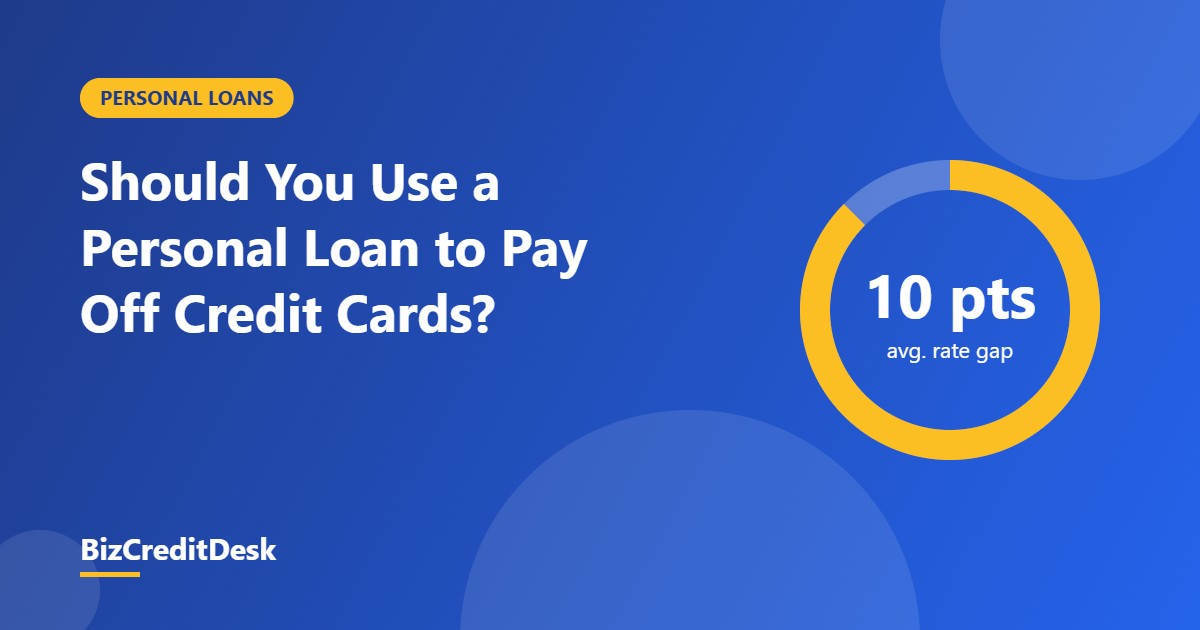
Personal loans usually charge much less than credit cards. According to the Federal Reserve’s G.19 report, in August 2026 the average rate was 11.90% on a 24-month personal loan at commercial banks, compared with about 22.36% on credit card accounts that were charged interest. That’s a gap of more than 10 percentage points.
| $8,000 of card debt | Monthly payment | Time to pay off | Total interest |
|---|---|---|---|
| Credit cards at 22% APR | $250 | About 4 years | About $4,150 |
| Personal loan at 12% APR, 3 years | About $266 | 3 years | About $1,570 |
In this example the loan saves around $2,500 in interest and you’re debt-free about a year sooner, for roughly $16 more a month. Your real savings depend on the rate you qualify for and any fees. To see how card interest adds up, read how credit card interest is calculated.
Other benefits
- One payment instead of many. Fewer due dates means fewer chances to miss one.
- A fixed end date. A loan has a set term, so you know exactly when you’ll be done.
- A possible credit score boost. Paying off cards lowers your credit utilization, which is a big part of your score.
When it’s not a good idea
- The loan rate isn’t much lower. If you only qualify for 25% or more, the savings may be small. Check what counts as a good personal loan rate.
- High fees. An origination fee of 5% or more can eat into your savings.
- You’ll keep using the cards. If the balances come back, you’ll have the loan and the card debt.
- A small balance you can clear soon. A 0% balance transfer card may be cheaper. Compare a consolidation loan vs. a balance transfer.
- The new payment doesn’t fit your budget. Missing loan payments hurts your credit. See what happens if you miss a loan payment.
How to do it, step by step
- List your cards with each balance, APR and minimum payment.
- Check your credit score and fix any errors first.
- Prequalify with several lenders using soft checks, and compare APRs.
- Borrow only what you need to clear the cards, including any fee.
- Pay the cards off right away, or choose a lender that pays your creditors directly.
- Keep the cards open but unused, if you can trust yourself. Closing old cards can lower your score.
- Set up autopay on the loan so you never miss a payment.
Want the bigger picture first? Read personal loan vs. credit card, what is debt consolidation and does debt consolidation hurt your credit.
Key takeaways
- Personal loans averaged 11.90% at banks in August 2026, versus about 22.36% on cards charged interest.
- Paying off cards with a loan can cut your interest and give you one fixed payment.
- It only works if the APR is clearly lower, fees are low and you stop adding to card balances.
- For small balances you can repay quickly, a 0% balance transfer may be cheaper.
Sources
This article is for educational purposes only and is not financial advice. See our Disclaimer.