
Last updated: November 1, 2026
You’ve probably heard that you should keep your credit card balances “under 30%.” It’s one of the most repeated pieces of credit advice, but it’s often misunderstood. Here’s what credit utilization actually is, why it matters so much, where the 30% figure comes from and how to lower your utilization quickly.
What is credit utilization?
Credit utilization is the share of your available revolving credit that you’re using. It’s calculated like this:
Credit utilization = total credit card balances ÷ total credit card limits × 100
Example: if you have two cards with limits of $4,000 and $6,000 ($10,000 total) and balances of $1,000 and $2,000 ($3,000 total), your overall utilization is 30%.
Scoring models look at both your overall utilization and the utilization on each individual card, so one maxed-out card can hurt even if your overall number looks fine.
Why it matters so much
Utilization falls under “amounts owed,” which makes up about 30% of your FICO score, second only to payment history (myFICO). VantageScore also ranks total credit usage among its most influential factors (VantageScore). Using a large share of your available credit can signal to lenders that you’re stretched thin.
The 30% rule: guideline, not magic number
The “30% rule” is a popular rule of thumb, not an official cutoff. There’s no cliff at 30% where your score suddenly drops. In general, lower is better. In a FICO analysis of people with very high scores, those consumers used an average of about 7% of their available revolving credit (FICO, 2012).
A practical way to think about it:
| Utilization | What it generally signals |
|---|---|
| Under 10% | Excellent; typical of people with top scores |
| 10%–29% | Good |
| 30%–49% | Getting high; may weigh on your score |
| 50% and above | High; likely hurting your score |
Using 0% isn’t necessarily ideal either: showing small balances that you pay off demonstrates active, responsible use.
The timing trick most people miss
Card issuers usually report your balance to the credit bureaus around your statement closing date, not your payment due date. So even if you pay in full every month, a large balance on your statement can show up as high utilization.
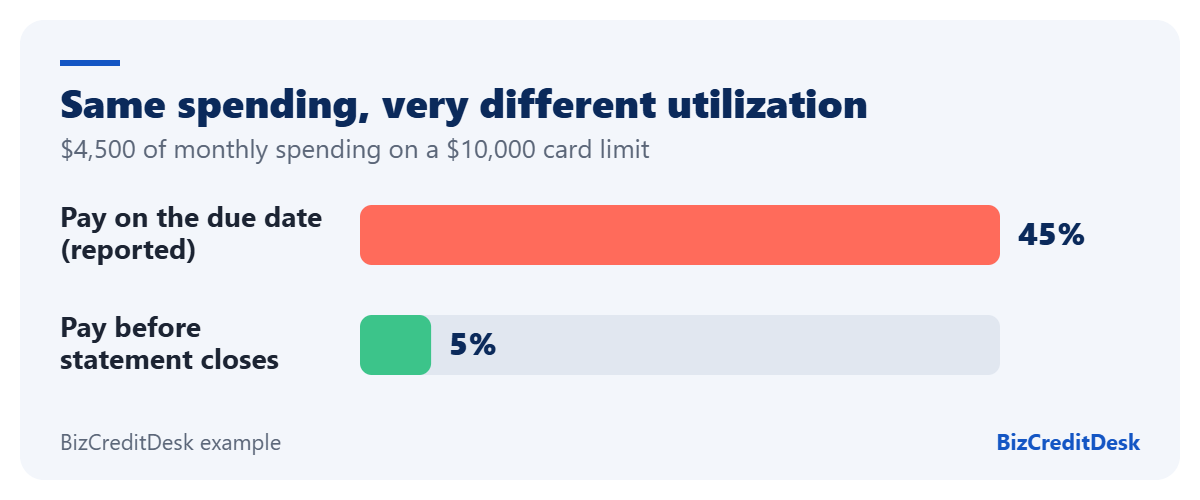
Example: you charge $4,500 a month on a card with a $10,000 limit and pay it off on the due date. Your reported utilization is about 45%. If you pay most of it down a few days before the statement closes, so the statement shows $500, your reported utilization drops to about 5%, even though you spend exactly the same.
In most scoring models used today, utilization is based on your most recently reported balances, so improvements can show up as soon as new, lower balances are reported.
7 ways to lower your credit utilization
- Pay down balances, starting with cards closest to their limits.
- Pay before your statement closing date, not just before the due date.
- Make multiple payments a month to keep running balances low.
- Request a credit limit increase on cards you manage well. Ask whether it involves a hard inquiry.
- Keep old cards open; closing one reduces your total available credit.
- Spread spending so no single card is near its limit.
- Consider consolidation: moving card balances to an installment loan lowers revolving utilization. See how debt consolidation affects your credit.
Common myths
- “Carrying a balance helps your score.” False. You don’t need to pay interest to build credit; pay your statement balance in full.
- “Utilization counts installment loans too.” Credit utilization mainly refers to revolving accounts like credit cards. Installment loan balances are considered differently.
- “High utilization stays on my score for years.” In most current scoring models, it reflects your latest reported balances, unlike late payments, which can stay for up to seven years (CFPB).
For the full picture, read how credit scores are calculated.
Key takeaways
- Utilization is your card balances divided by your card limits.
- It’s part of “amounts owed,” about 30% of your FICO score.
- Under 30% is a guideline; under 10% is even better.
- Paying before your statement closes can lower reported utilization fast.
Sources
This article is for educational purposes only and is not financial advice. Scoring models vary. See our Disclaimer.