
Last updated: November 1, 2026
Your credit score affects whether you’re approved for a loan, a credit card or even an apartment, and how much you pay in interest. Yet most people have no idea how that three-digit number is actually calculated. The good news is that the formula isn’t a mystery: the scoring companies publish the main factors and roughly how much each one matters. Once you understand them, you’ll know exactly where to focus to raise your score.
FICO vs. VantageScore: the two main scores
There are two major credit scoring brands in the U.S.:
- FICO scores are the most widely used by lenders. They range from 300 to 850.
- VantageScore was created by the three credit bureaus and also ranges from 300 to 850 in its current versions (VantageScore). Many free credit monitoring apps show a VantageScore.
Both are calculated from the information in your credit reports at Equifax, Experian and TransUnion. Because each bureau may have slightly different information, and because there are several versions of each score, it’s normal to see different numbers in different places.
The 5 factors in your FICO score
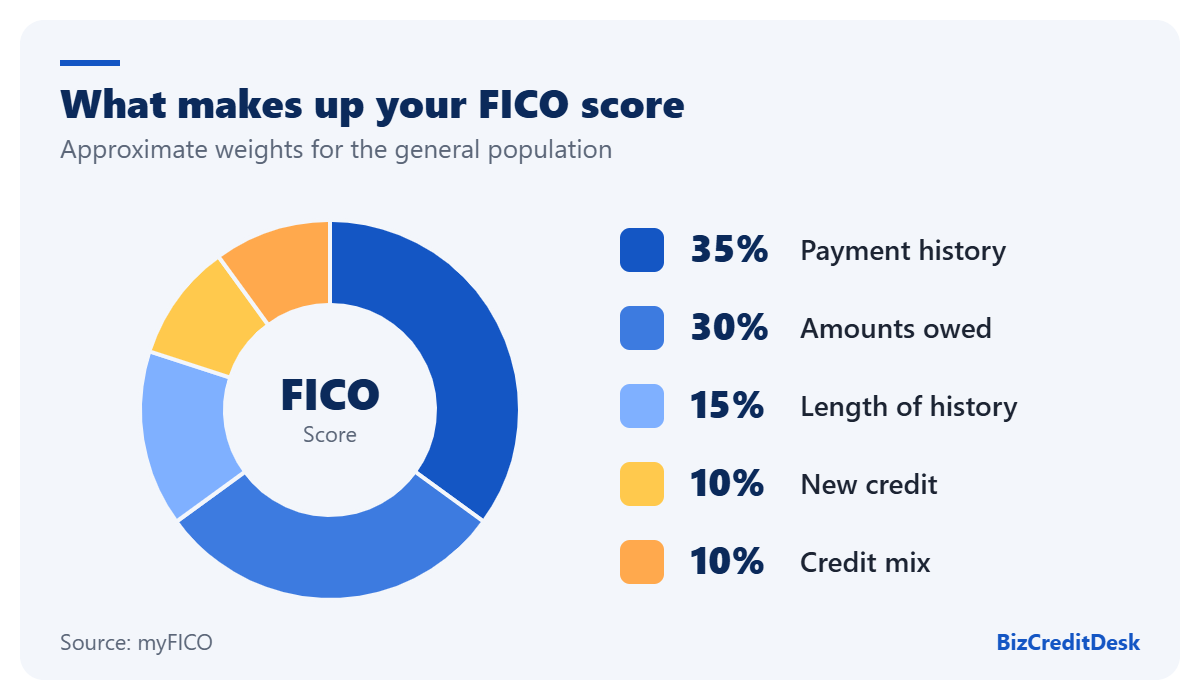
According to myFICO, here’s how the general population’s FICO scores are weighted (myFICO):
1. Payment history: 35%
The most important factor is simply whether you’ve paid your bills on time. Late payments, collections and bankruptcies all hurt, and recent problems hurt more than old ones. Most negative items can stay on your credit report for seven years, and bankruptcies for up to ten (CFPB).
What to do: set up autopay for at least the minimum payment on every account.
2. Amounts owed: 30%
This looks at how much you owe, and especially at your credit utilization: your credit card balances divided by your total credit limits. Using a large share of your available credit suggests higher risk.
Example: $2,000 in balances on $10,000 of total limits is 20% utilization. The same $2,000 on a $2,500 limit is 80%.
What to do: keep card balances low relative to your limits. Many experts suggest staying under 30%, and lower is better. Paying down balances before your statement closing date can help, since that’s usually when balances are reported.
3. Length of credit history: 15%
Scores consider how long your accounts have been open, including your oldest account and the average age of all accounts.
What to do: think twice before closing your oldest cards, especially if they have no annual fee.
4. New credit: 10%
Opening several accounts in a short time can signal risk. Each hard inquiry usually takes less than five points off a FICO score for most people (myFICO), and FICO only counts inquiries from the past 12 months.
What to do: apply for new credit only when you need it, and use prequalification (a soft check) to compare offers first.
5. Credit mix: 10%
Having experience with different types of credit, such as credit cards (revolving) and loans (installment), can help slightly.
What to do: don’t open accounts just to improve your mix. This factor matters least.
How VantageScore differs
VantageScore uses similar ingredients but doesn’t publish exact percentages. It ranks its factors from most to least influential: payment history, total credit usage, credit mix and experience, new accounts opened, and balances and available credit (VantageScore). In practice, the same habits that improve your FICO score improve your VantageScore too.
What does NOT affect your credit score
- Your income, job title or savings balance
- Your age, race, religion, sex, marital status or national origin
- Checking your own credit (that’s a soft inquiry)
- Prequalification offers that use a soft credit check
- Your debit card use
Lenders may still look at your income and other details when you apply, but those aren’t part of the score itself.
How long negative information lasts
| Item | How long it can stay on your report |
|---|---|
| Late payments | Up to 7 years |
| Collections | Up to 7 years |
| Bankruptcy | Up to 10 years |
| Hard inquiries | Up to 2 years (FICO counts only the last 12 months) |
A simple plan to raise your score
- Check your reports for free at AnnualCreditReport.com and dispute any errors.
- Never miss a payment; set up autopay on every account.
- Pay down credit card balances, starting with the cards closest to their limits.
- Keep old accounts open when it makes sense.
- Space out new applications and prequalify before you apply.
If you’re planning to borrow soon, see what credit score you need for a personal loan.
Key takeaways
- Payment history (35%) and amounts owed (30%) make up nearly two-thirds of your FICO score.
- Credit utilization is one of the fastest factors to improve.
- FICO and VantageScore use similar factors, so good habits help both.
- Most negative items fall off your report after seven years.
Sources
This article is for educational purposes only and is not financial advice. Scoring models and their weights can vary by version and by individual credit file. See our Disclaimer.