
Last updated: November 1, 2026
“What credit score do I need?” is usually the first question people ask before applying for a personal loan. The honest answer is that there’s no single magic number. Each lender sets its own rules, and your score is only part of the picture. What your score really decides is how easy it is to get approved and how much you’ll pay. This guide explains how lenders read your score, what to expect in each range and how to improve your odds before you apply.
Is there a minimum credit score for a personal loan?
There’s no legal or industry-wide minimum. Some lenders focus on borrowers with strong credit, while others specialize in fair or poor credit and charge more to offset the risk. Lenders also weigh your income, existing debts and the loan amount, not just your score (CFPB).
As a general rule, the higher your score, the more lenders will compete for your business and the lower your APR is likely to be.
FICO score ranges explained
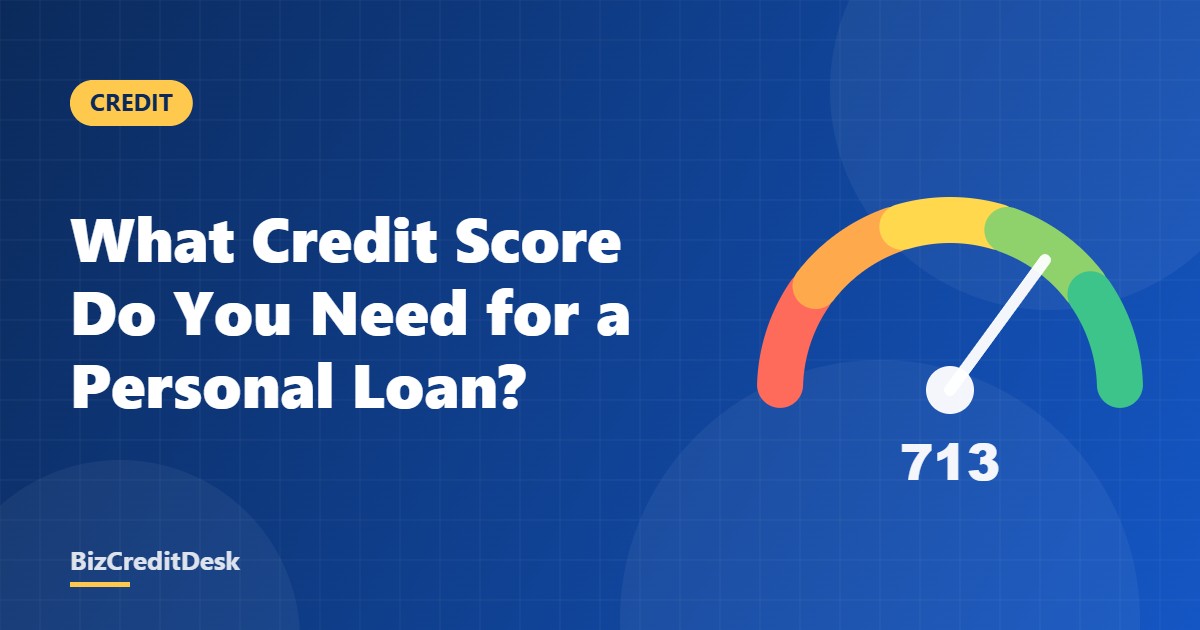
Most lenders use FICO scores, which run from 300 to 850. Experian groups FICO Score 8 results into these ranges, and reports that the average U.S. FICO score was 713 at the close of 2025 (Experian):
| FICO score | Rating | What it usually means for a personal loan |
|---|---|---|
| 800–850 | Exceptional | Access to the lowest advertised rates and the widest choice of lenders. |
| 740–799 | Very good | Strong approval odds and very competitive rates. |
| 670–739 | Good | Approval with most mainstream lenders, though not always their best rates. |
| 580–669 | Fair | Fewer options and noticeably higher APRs; credit unions and some online lenders may help. |
| 300–579 | Poor | Approval is difficult; expect high costs and consider a cosigner or secured option. |
The “what it means” column is a general guide, not a promise. Two people with the same score can get different offers because of income, debt and employment history.
Why your score changes the cost so much
The average rate on a 24-month personal loan at commercial banks was 11.90% in August 2026 (Federal Reserve G.19). Borrowers with excellent credit can often beat that average, while borrowers with fair or poor credit may be offered rates far above it.
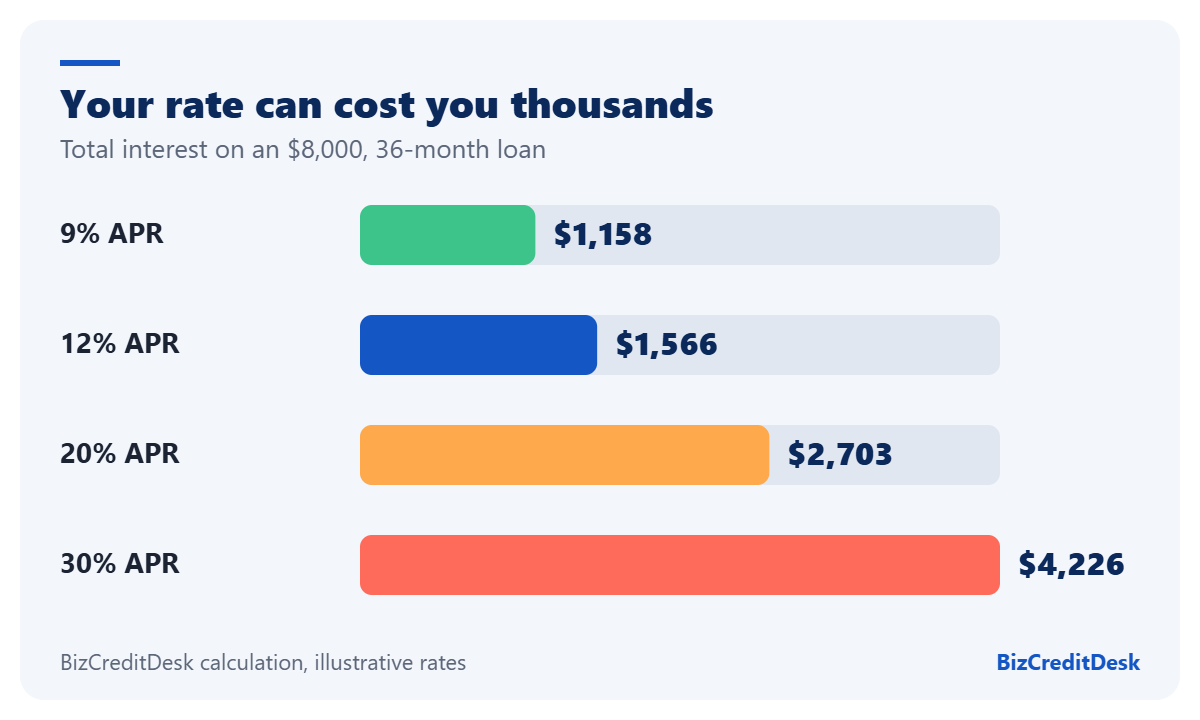
Here’s how much the rate alone changes the cost of an $8,000 loan over 36 months:
| APR | Monthly payment | Total interest |
|---|---|---|
| 9% | $254 | $1,158 |
| 12% | $266 | $1,566 |
| 20% | $297 | $2,703 |
| 30% | $340 | $4,226 |
The figures above are illustrations of how APR affects cost, not quotes for any specific credit score. The takeaway: moving from a 30% offer to a 12% offer on the same loan would save you more than $2,600.
What goes into your FICO score
Knowing what drives your score shows you where to focus. According to myFICO, the general weights are (myFICO):
- Payment history (35%): whether you’ve paid past accounts on time.
- Amounts owed (30%): how much you owe, including how much of your credit card limits you’re using.
- Length of credit history (15%): how long your accounts have been open.
- New credit (10%): recent applications and newly opened accounts.
- Credit mix (10%): the variety of credit types you manage.
Other things lenders look at
- Income and job stability: lenders want to see you can afford the payment.
- Debt-to-income ratio (DTI): your monthly debt payments divided by your gross monthly income. A lower DTI can offset a so-so score.
- Recent negative marks: a recent late payment or collection weighs more than an old one.
- Loan amount and term: a smaller loan is often easier to get approved.
How to improve your chances before you apply
- Check your credit reports for free at AnnualCreditReport.com and dispute any errors.
- Pay down credit card balances. Because amounts owed make up about 30% of your FICO score, lowering your card balances can lift your score relatively quickly once the new balances are reported.
- Make every payment on time. Payment history is the single biggest factor.
- Avoid new credit applications in the months before you apply.
- Prequalify with soft checks to see likely rates without hurting your score, then submit one formal application. Our step-by-step personal loan guide explains how.
Options if your credit is fair or poor
- Credit unions. Federal credit unions can offer small “payday alternative loans” (PALs) of up to $2,000, with interest capped at 28% (America’s Credit Unions). Membership rules apply.
- A cosigner. Someone with stronger credit agrees to repay if you don’t. It can lower your rate, but it puts their credit at risk too.
- A secured loan. Backing the loan with savings or a certificate of deposit can make approval easier and the rate lower.
- Waiting and rebuilding. If the loan isn’t urgent, a few months of on-time payments and lower card balances can move you into a better tier.
Be very cautious with offers that promise approval with “no credit check.” The Federal Trade Commission warns that guaranteed approval and upfront fees are classic signs of loan scams (FTC).
Key takeaways
- There’s no universal minimum score, but a higher score means more options and lower rates.
- Scores of 670 and above are considered “good” on the FICO scale; the U.S. average is around 713.
- The rate you get can change the total cost of a loan by thousands of dollars.
- Paying down card balances and paying on time are the fastest ways to improve your profile.
- If your credit is weak, look at credit unions, cosigners or secured loans before high-cost lenders.
Sources
This article is for educational purposes only and is not financial advice. Rates and lending criteria change frequently; always confirm current terms with the lender. See our Disclaimer.