
Last updated: November 1, 2026
Every time someone checks your credit, it’s recorded as an “inquiry.” Some inquiries can lower your score a little; others have no effect at all. Knowing the difference lets you shop for loans and cards without worrying, and spot inquiries that shouldn’t be there. Here’s what you need to know about hard and soft credit inquiries.
Hard vs. soft inquiries at a glance
| Hard inquiry | Soft inquiry | |
|---|---|---|
| When it happens | You apply for new credit | Your credit is checked for other reasons |
| Examples | Loan, credit card or mortgage applications | Checking your own credit, prequalification, account reviews, prescreened offers, many employment checks |
| Affects your score? | Can, slightly | No |
| Who can see it | Anyone who pulls your report | Only you |
| Needs your permission? | Generally, yes, through your application | Not always |
Source: CFPB.
What is a hard inquiry?
A hard inquiry happens when a lender checks your credit because you’ve applied for credit, such as a personal loan, credit card or mortgage. The CFPB explains that hard inquiries can lower your score because most scoring models consider how often and how recently you apply for credit (CFPB).
How much does a hard inquiry hurt?
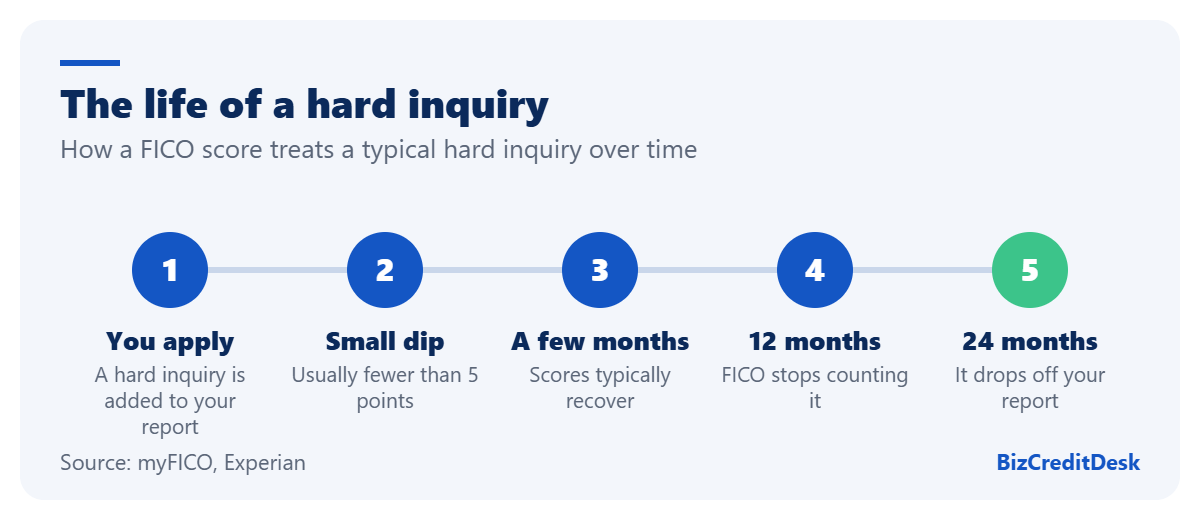
Usually not much. According to FICO, for most people one additional inquiry takes less than five points off their FICO scores, though the effect can be larger for people with few accounts or a short credit history (myFICO). New credit, which includes inquiries, makes up about 10% of a FICO score (myFICO).
How long does it last?
Hard inquiries can stay on your credit report for up to two years, but FICO scores only consider them for 12 months (myFICO). Experian notes scores typically recover within a few months if the rest of your history is positive (Experian).
What is a soft inquiry?
A soft inquiry is any credit check that isn’t tied to a credit application. According to the CFPB, examples include (CFPB):
- Checking your own credit report or score
- Prescreened (“pre-approved”) credit offers
- Your current lenders reviewing your existing accounts
- Employment background checks
Many lenders also use soft checks for prequalification, which shows you estimated rates without affecting your score. Soft inquiries don’t affect your credit score, so you can check your own credit as often as you like.
Rate shopping: how to compare without hurting your score
FICO treats multiple inquiries for mortgages, auto loans and student loans within a short window (14 or 45 days, depending on the score version) as a single inquiry, so you can shop for those without being penalized for each application (myFICO).
That rule doesn’t cover personal loans or credit cards, so for those:
- Prequalify first with several lenders using soft checks.
- Compare offers by APR and total cost.
- Submit one formal application to the lender you choose.
Our step-by-step personal loan guide walks through this process.
Is it a hard or soft inquiry? Common situations
| Situation | Usually |
|---|---|
| Applying for a credit card | Hard |
| Applying for a personal, auto or mortgage loan | Hard |
| Prequalifying for a loan or card | Soft |
| Checking your own credit score | Soft |
| Receiving a “pre-approved” offer in the mail | Soft |
| Your card issuer reviewing your account | Soft |
| Requesting a credit limit increase | Varies; ask your issuer first |
| Opening a bank account, renting, setting up utilities | Varies; ask which type they use |
Found an inquiry you don’t recognize?
A hard inquiry you didn’t authorize could be a sign of identity theft. Contact the company listed, and if it’s fraudulent, dispute it with the credit bureau and report it at IdentityTheft.gov. Our guide on how to read your credit report and dispute errors explains the steps.
Key takeaways
- Hard inquiries come from credit applications and can lower your score slightly.
- Soft inquiries, including checking your own credit and prequalification, don’t affect your score.
- For most people, a hard inquiry costs fewer than five FICO points and counts for 12 months.
- Prequalify first, then apply once, especially for personal loans and credit cards.
Sources
This article is for educational purposes only and is not financial advice. See our Disclaimer.