
Last updated: November 1, 2026
If you’re juggling several credit card bills with different due dates and high interest rates, debt consolidation can sound like the perfect fix: one payment, one rate, less stress. Done right, it can save you thousands of dollars and help you get out of debt faster. Done wrong, it can leave you with a longer repayment period, extra fees, or even more debt than before. Here’s how debt consolidation works, the main options, and how to tell whether it makes sense for you.
What is debt consolidation?
Debt consolidation means combining several debts, most often credit card balances, into a single new debt. Ideally, the new debt has a lower interest rate, a fixed payoff date, or both. You then make one monthly payment instead of several.
Consolidation doesn’t erase or reduce what you owe. It changes how you repay it. That’s an important difference from debt settlement, which we cover below.
Why the numbers can work in your favor
The gap between credit card rates and personal loan rates is large. In August 2026, the average rate on credit card accounts that were charged interest was 22.36%, while the average rate on a 24-month personal loan at commercial banks was 11.90% (Federal Reserve G.19).
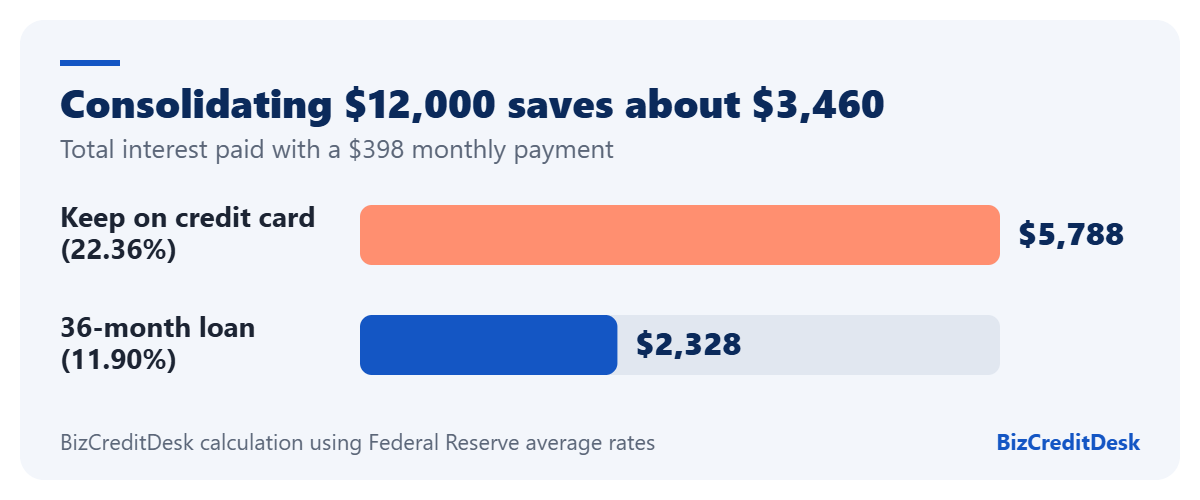
Here’s an example with $12,000 of credit card debt and a monthly payment of $398 either way:
| Option | APR | Time to pay off | Total interest |
|---|---|---|---|
| Keep the credit card debt | 22.36% | 45 months | $5,788 |
| 36-month consolidation loan | 11.90% | 36 months | $2,328 |
In this example, consolidating saves about $3,460 in interest and finishes the debt nine months sooner. Your results depend on the rate you actually qualify for and any fees.
But watch the term: the same $12,000 loan stretched to 60 months lowers the payment to about $266, yet total interest rises to roughly $3,980. A lower payment isn’t the same as a cheaper loan.
The main ways to consolidate debt
The CFPB describes three common approaches (CFPB):
1. Debt consolidation loan
You take out a personal loan from a bank, credit union or online lender and use it to pay off your cards. You get a fixed rate, a fixed monthly payment and a clear end date.
- Best for: people with fair to good credit who want a predictable payoff plan.
- Watch out for: origination fees and long terms that increase total interest.
2. Balance transfer credit card
You move your balances to a card offering a low or 0% promotional rate for a limited time. A transfer fee usually applies, charged as a percentage of the amount moved or a flat minimum, whichever is greater.
- Best for: people with good credit who can pay off the full balance before the promotion ends.
- Watch out for: the rate jumping when the promotion expires. The CFPB also warns that new purchases on the card may not get a grace period, and that paying more than 60 days late can let the issuer raise the rate on your whole balance.
3. Home equity loan or line of credit
You borrow against the value of your home and use the money to pay off other debts. Rates are often lower because your house secures the loan.
- Best for: homeowners with significant equity and very stable finances.
- Watch out for: the biggest risk of all. You turn unsecured credit card debt into debt secured by your home, so falling behind could lead to foreclosure. Closing costs can also run from hundreds to thousands of dollars.
Comparison at a glance
| Consolidation loan | Balance transfer card | Home equity | |
|---|---|---|---|
| Rate type | Usually fixed | Promo rate, then variable | Fixed or variable |
| Typical costs | Origination fee | Transfer fee | Closing costs |
| Collateral | None (usually) | None | Your home |
| Main risk | Long term raises total cost | Rate jumps after promo | Foreclosure |
Does debt consolidation hurt your credit?
It can cause a small, temporary dip, and then help over time:
- Short term: applying usually involves a hard inquiry, and a new account lowers the average age of your accounts.
- Medium term: paying off your cards lowers your credit utilization (how much of your available card credit you’re using), which is a major scoring factor and can raise your score.
- Long term: a record of on-time payments on the new loan builds your history.
Tip: consider keeping paid-off cards open (unless they charge an annual fee) so your available credit stays high, but put them away so you don’t run the balances up again.
Debt consolidation vs. debt settlement
These are often confused, but they’re very different. With consolidation, you repay everything you owe, ideally at a lower rate. With debt settlement, a company tries to negotiate with your creditors to accept less than you owe.
The CFPB warns that debt settlement companies often charge fees, may tell you to stop paying your creditors and ask you to deposit money into a special account, an approach that is risky and can seriously damage your credit (CFPB). Be skeptical of any offer that sounds too good to be true.
When debt consolidation makes sense
- You qualify for a rate meaningfully lower than what you pay now.
- You can afford the new monthly payment comfortably.
- You’ve identified why the debt built up and have a plan to stop adding to it.
- The total cost (interest plus fees) is lower than your current path.
When it probably doesn’t
- You spend more than you earn each month. As the CFPB points out, consolidation won’t fix that, and you could end up deeper in debt.
- Your credit history means the only offers you get carry rates close to your current ones.
- Your debt is small enough to pay off within a year or so with a focused budget.
Alternatives worth trying first
- Call your card issuers. The CFPB notes creditors may agree to lower your rate, waive fees, reduce minimum payments or move your due date.
- Talk to a nonprofit credit counselor. Agencies affiliated with the National Foundation for Credit Counseling offer free or low-cost budget reviews and may suggest a debt management plan.
- Use a payoff strategy. Paying the highest-rate card first (the “avalanche” method) minimizes interest; paying the smallest balance first (the “snowball” method) builds momentum.
How to consolidate debt: step by step
- List every debt with its balance, interest rate and minimum payment.
- Check your credit reports for free at AnnualCreditReport.com.
- Prequalify with several lenders or card issuers using soft credit checks.
- Compare the total cost of each option, including fees, against keeping your current debts.
- Apply for the best option and use the funds to pay off the old debts right away.
- Set up autopay and commit to not adding new balances to the paid-off cards.
Key takeaways
- Debt consolidation combines several debts into one, ideally at a lower rate.
- The main options are a personal loan, a balance transfer card or a home equity loan, each with different risks.
- Compare total cost, not just the monthly payment.
- Consolidation only works if you stop the debt from building up again.
- Be wary of debt settlement offers and anyone charging large upfront fees.
Sources
This article is for educational purposes only and is not financial advice. Rates and terms change frequently; always confirm current terms with the lender. See our Disclaimer.