
Last updated: November 1, 2026
A personal loan can be a smart way to pay for a large expense or replace expensive credit card debt with a single fixed payment. It can also be an expensive mistake if you borrow more than you need, skip the fine print or accept the first offer you get. This guide walks you through the process step by step, from checking your credit to signing the loan agreement, so you can borrow on your terms.
What is a personal loan?
A personal loan is an installment loan: you receive the full amount up front and repay it in equal monthly payments over a set term, usually between one and seven years. The Consumer Financial Protection Bureau (CFPB) describes these as closed-end loans that people commonly use for large purchases, unexpected expenses or debt consolidation (CFPB).
Most personal loans are unsecured, meaning you don’t put up collateral such as a car or savings account. Because the lender takes more risk, your credit history and income matter a lot in deciding whether you qualify and what rate you pay.
How much does a personal loan cost right now?
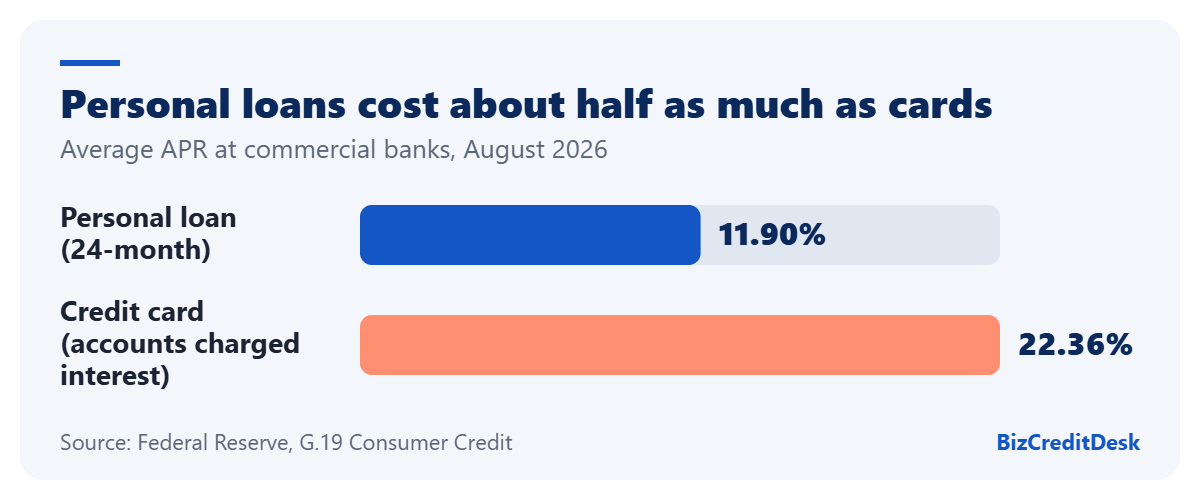
According to the Federal Reserve’s latest consumer credit report, the average interest rate on a 24-month personal loan at commercial banks was 11.90% in August 2026, compared with 22.36% on credit card accounts that were charged interest (Federal Reserve G.19). Your own rate can be much lower or much higher than the average depending on your credit profile, income and the lender.
Here’s what the average rate means in dollars:
| Loan amount | APR | Term | Monthly payment | Total interest |
|---|---|---|---|---|
| $10,000 | 11.90% | 24 months | $470 | $1,286 |
| $10,000 | 11.90% | 36 months | $332 | $1,940 |
Notice the trade-off: the longer term lowers your monthly payment by about $138 but costs you roughly $650 more in interest.
Step 1: Decide exactly how much you need
Start with the real cost of what you’re paying for, then borrow only that amount. Lenders may approve you for more than you asked, but every extra dollar adds interest. If you’re consolidating debt, add up the exact payoff balances, not the minimum payments.
Then check that the monthly payment fits your budget. A useful test: could you still cover rent, utilities, food and a small emergency cushion if the payment came out of your account today?
Step 2: Check your credit reports and score
Your credit history is the biggest factor in your rate. Before applying:
- Get your free credit reports from Equifax, Experian and TransUnion at AnnualCreditReport.com, the official site authorized by federal law.
- Look for errors such as accounts you don’t recognize or late payments reported by mistake, and dispute them before you apply.
- Know your score range. On the FICO scale, scores from 670 to 739 are considered “good” and 740 or higher “very good.” There is no single minimum for a personal loan, but borrowers with higher scores typically receive lower rates.
Step 3: Know what lenders look at
The CFPB notes that lenders typically consider your credit score and reports, income, existing debts, the loan amount and length, and sometimes your bank account activity (CFPB). In practice, that means:
- Credit history: on-time payments and low credit card balances help.
- Income and employment: expect to provide pay stubs, tax returns or bank statements.
- Debt-to-income ratio (DTI): your monthly debt payments divided by your gross monthly income. Lower is better; many lenders prefer to see it well under 40%.
Step 4: Compare lenders and prequalify
Personal loans are offered by banks, credit unions and online lenders. Credit unions often have competitive rates for members, while online lenders may decide faster. Compare at least three offers.
Many lenders let you prequalify with a soft credit check, which shows an estimated rate without affecting your credit score. A formal application usually triggers a hard inquiry. Keep in mind that FICO’s rate-shopping rule, which counts several inquiries in a short window as one, applies to mortgage, auto and student loans (myFICO). Personal loan applications aren’t covered by that rule, so prequalify first and formally apply only with your top choice. Hard inquiries stay on your report for up to two years, but FICO scores only consider them for 12 months.
Step 5: Compare the full cost, not just the rate
Always compare the APR (annual percentage rate), which includes certain fees, rather than the interest rate alone. The CFPB lists fees that personal loans may carry, including origination fees, documentation fees, optional credit insurance and late fees (CFPB).
For a worked example with three real-looking offers, see how to compare personal loan offers.
The origination fee deserves special attention because it is often deducted from the loan before you receive it. On a $10,000, 36-month loan at 11.90% with a 5% origination fee, you would receive only $9,500 but repay the full $10,000 plus interest, which raises the effective APR to about 15.5%.
Use this checklist for every offer:
- APR and whether the rate is fixed or variable
- Monthly payment and total amount repaid
- Origination fee and whether it’s deducted from the loan
- Late fees and returned-payment fees
- Prepayment penalty (ideally none)
- How quickly funds are delivered
Step 6: Apply and gather your documents
Once you’ve picked an offer, you’ll usually need:
- A government-issued photo ID
- Proof of address
- Proof of income (recent pay stubs, W-2s or tax returns)
- Your Social Security number
- Bank account details for the deposit
Read the loan agreement carefully before signing. The terms you sign are what matter, not the advertisement.
Step 7: Plan your repayment
Set up automatic payments so you never miss a due date; some lenders even offer a small rate discount for autopay. If you run into trouble, contact your lender right away and ask about options such as a payment plan, because missed payments can lead to collections and damage your credit (CFPB).
Red flags to avoid
- Upfront fees before you get the loan. The Federal Trade Commission warns that a lender asking for a processing or insurance fee before you get the money, or guaranteeing approval regardless of your credit, is a classic scam sign (FTC).
- Pressure to sign immediately or to borrow more than you asked for.
- “No credit check, guaranteed approval” offers, which often come with very high costs.
- Add-on insurance you didn’t request bundled into the loan.
When a personal loan may not be the right move
A personal loan makes the most sense when it replaces more expensive debt or pays for a necessary expense you can’t cover from savings. It’s usually a poor fit for discretionary spending, or when the monthly payment would stretch your budget. If you’re struggling with debt overall, a nonprofit credit counselor can review your options for free.
Key takeaways
- Borrow only what you need and make sure the payment fits your budget.
- Check your credit reports for errors before applying.
- Prequalify with several lenders using soft checks, then apply with your best offer.
- Compare APRs and origination fees, not just interest rates.
- Set up autopay and contact your lender early if problems arise.
Sources
This article is for educational purposes only and is not financial advice. Rates and terms change frequently; always confirm current terms with the lender. See our Disclaimer.