
Last updated: November 1, 2026
Your credit report is the raw material behind your credit score. If it contains a mistake, such as a late payment you never made or an account that isn’t yours, it can cost you a loan approval or hundreds of dollars in extra interest. The good news: you can check your reports for free and dispute errors yourself, without paying anyone. Here’s how.
Step 1: Get your free credit reports
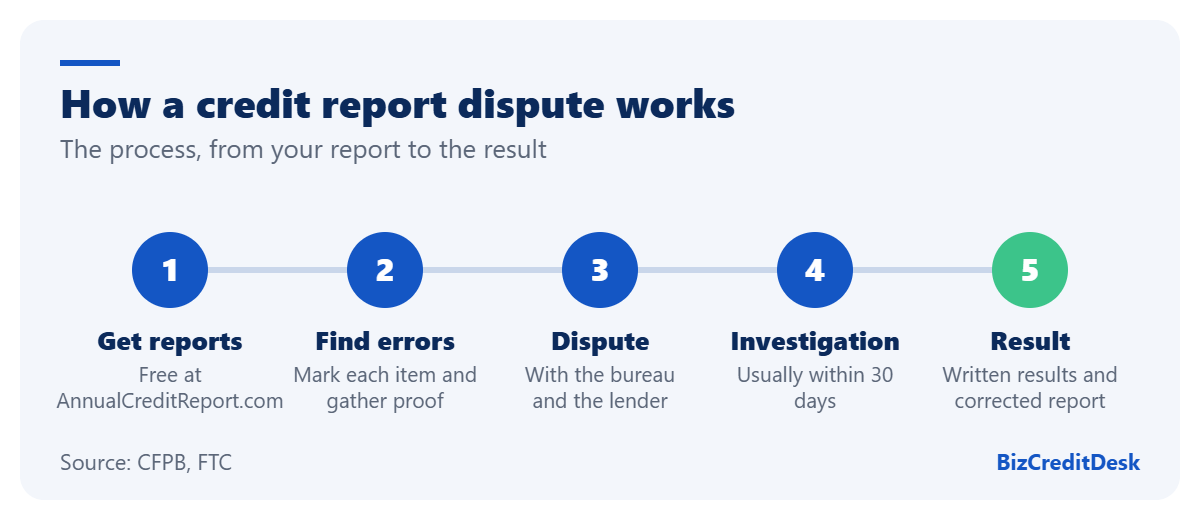
You have reports at each of the three nationwide credit bureaus: Equifax, Experian and TransUnion. The official place to get them for free is AnnualCreditReport.com, and the bureaus have permanently extended free weekly access there (FTC).
Check all three. Lenders don’t always report to every bureau, so an error may appear on one report and not the others.
Step 2: Understand what’s on your report
| Section | What it shows | What to check |
|---|---|---|
| Personal information | Name, addresses, Social Security number, employers | Misspellings, addresses you never lived at |
| Accounts (tradelines) | Credit cards, loans, balances, limits, payment history | Accounts you don’t recognize, wrong balances, incorrect late payments, closed accounts shown as open |
| Collections | Debts sent to collection agencies | Debts that aren’t yours, paid debts still shown as unpaid, duplicates |
| Public records | Bankruptcies | Records that aren’t yours or are too old |
| Inquiries | Who has checked your credit | Hard inquiries you didn’t authorize |
Step 3: Spot the most common errors
- Accounts that belong to someone else, often someone with a similar name
- Late payments reported when you paid on time
- The same debt listed more than once
- Wrong balances or credit limits
- Old negative items that should have aged off
- Accounts opened by an identity thief
Know the time limits: most negative items, like late payments and collections, can stay on your report for seven years, and bankruptcies for up to ten (CFPB).
If you see accounts you didn’t open, you may be a victim of identity theft. Report it at IdentityTheft.gov.
Step 4: Dispute with the credit bureau
You can dispute online, by mail or by phone with each bureau that shows the error. The CFPB recommends explaining in writing what’s wrong and why, and including copies (never originals) of supporting documents (CFPB). Your dispute should include:
- Your full name, address and contact information
- Each error, with the account number
- Why the information is wrong
- A request to correct or remove it
- A copy of your report with the errors marked
- Copies of proof, such as bank statements or payment confirmations
If you mail it, use certified mail with a return receipt, and keep copies of everything.
Step 5: Dispute with the company that reported it
You can also dispute directly with the “furnisher,” the lender or collector that sent the information to the bureaus. Furnishers generally must investigate and respond within 30 days, and if they find the information is wrong or can’t verify it, they must correct it and notify all the bureaus (CFPB).
What happens next
- The bureau has 30 days to investigate your dispute (FTC).
- It forwards your evidence to the furnisher, which must investigate and report back.
- You’ll receive the results in writing. If your report changes, you’re entitled to a free updated copy.
- You can ask the bureau to notify anyone who received your report in the past six months.
- If a dispute is rejected as “frivolous,” the bureau must tell you why, and you can resubmit with more evidence.
If your dispute is denied
- Send additional documentation and dispute again.
- Ask the bureau to add a brief statement explaining your side to your file.
- Submit a complaint to the CFPB.
Beware of credit repair scams
You don’t need to pay anyone to fix errors; disputing is free and you can do it yourself. The CFPB warns that companies claiming they can remove accurate, current negative information are likely running a scam (CFPB). Accurate negative information generally stays until its time limit expires; what you can remove are mistakes.
Why it’s worth the effort
Payment history and amounts owed together make up about 65% of a FICO score (myFICO), so a wrong late payment or an inflated balance can have a real effect. A cleaner report can mean better offers when you apply for a personal loan or consolidate debt.
Key takeaways
- Check all three reports for free at AnnualCreditReport.com, now available weekly.
- Dispute errors in writing with both the bureau and the company that reported them.
- Bureaus generally have 30 days to investigate and must send you the results.
- Disputing is free; be wary of anyone who promises to erase accurate information.
Sources
This article is for educational purposes only and is not legal or financial advice. See our Disclaimer.