
Last updated: November 17, 2026
Inflation doesn’t just make groceries and gas more expensive. It also shapes how much you pay to borrow money, from credit cards to personal loans, and how much you earn on your savings. Understanding the connection helps you make smarter decisions about when and how to borrow, and which debts to tackle first.
Where inflation and rates stand right now
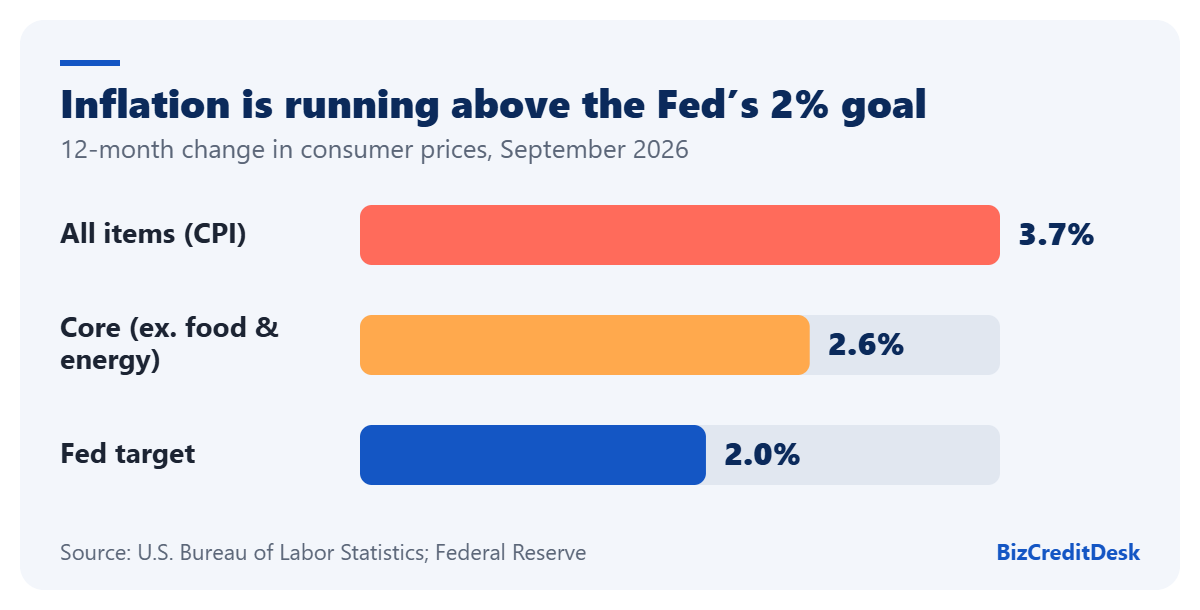
- Inflation: the latest annual figure shows consumer prices up 3.7% over the 12 months ending in September 2026, with “core” inflation (excluding food and energy) at 2.6%. In October, prices rose another 0.4% for the month and core prices 0.3%. The Bureau of Labor Statistics didn’t publish a 12-month rate for October because the 2025 government shutdown left no October 2025 data to compare against (Bureau of Labor Statistics).
- The Fed’s benchmark rate: the Federal Reserve held its target range for the federal funds rate at 3.75% to 4.00% on October 28, 2026, after raising it a quarter point in September. Two policymakers voted for another increase (Federal Reserve).
- Borrowing costs: in August 2026, the average credit card rate on accounts charged interest was 22.36%, and the average 24-month personal loan rate at commercial banks was 11.90% (Federal Reserve G.19).
The next Consumer Price Index report, covering November, is scheduled for December 10, 2026, and the Fed announces its next rate decision on December 9 (BLS, Federal Reserve). We update this page as new data comes out.
How inflation pushes up borrowing costs
The Federal Reserve’s goal is to keep inflation around 2% over time. When inflation runs above that, the Fed can raise its benchmark rate to cool demand. That decision ripples through the economy:
- The Fed raises the federal funds rate, the rate banks charge each other for overnight loans.
- Banks raise the prime rate, which is commonly set about 3 percentage points above the top of the Fed’s range.
- Variable-rate debts follow, especially credit cards, whose APRs are usually tied to the prime rate.
- New fixed-rate loans get pricier, as lenders’ own funding costs rise.
When inflation cools, the process can run in reverse, but rate cuts usually come gradually.
Credit cards: the fastest to react
Most credit cards have variable APRs. When the Fed raises rates, card issuers typically pass the increase on within one or two billing cycles. Even a quarter-point rise adds up on large balances, and with average card rates above 22%, carrying a balance is already expensive.
What to do: paying down card balances is one of the best guaranteed “returns” available. If you can’t pay them off quickly, consider whether debt consolidation at a fixed rate makes sense.
Personal loans: fixed rates protect you
Most personal loans have fixed rates, so if you already have one, rising rates won’t change your payment. New borrowers, however, will see offers that reflect current conditions. Learn more about how personal loan interest rates work.
What to do: if you need to borrow and rates may keep rising, locking in a fixed rate can bring predictability. Compare APRs across several lenders before you commit.
Mortgages and home equity lines
Fixed-rate mortgages don’t change once you’ve locked in. Adjustable-rate mortgages and home equity lines of credit (HELOCs), however, are usually tied to benchmark rates and can become more expensive when rates rise.
Savings: the upside of higher rates
Higher rates also mean better yields on high-yield savings accounts, money market accounts and certificates of deposit. The key number is your real return: your interest rate minus inflation. If your savings earn less than the inflation rate, your money is losing purchasing power, even though the balance grows.
How inflation affects your budget and debt
Inflation can make debt harder to manage indirectly: when everyday expenses rise faster than your income, there’s less left over for loan payments. On the other hand, a fixed loan payment becomes relatively easier to handle over time if your wages rise with inflation.
Smart moves when inflation is high
- Attack variable-rate debt first, especially high-interest credit cards. Our guide to debt snowball vs. avalanche can help you choose an order.
- Prefer fixed rates for new borrowing when possible.
- Keep an emergency fund in an account that pays a competitive rate.
- Review your budget every few months as prices change.
- Protect your credit score; the better your score, the less rising rates will hurt your offers.
Key takeaways
- Higher inflation often leads the Fed to raise rates, which pushes up borrowing costs.
- Credit cards and other variable-rate debts react fastest.
- Existing fixed-rate loans aren’t affected; new loans are.
- Savers can benefit from higher rates, as long as they beat inflation.
Sources
This article is for educational purposes only and is not financial advice. Economic data and rates change frequently. See our Disclaimer.