

Last updated: November 8, 2026
Bank failures are rare, but they do happen. When they do, deposit insurance from the Federal Deposit Insurance Corporation (FDIC) is what keeps your savings safe. Since the FDIC was created in 1934, no depositor has lost a penny of insured funds. The key word is “insured”: coverage has limits and doesn’t apply to everything a bank sells.
The short version
| Covered by FDIC | Not covered by FDIC |
|---|---|
| Checking accounts | Stocks, bonds and mutual funds |
| Savings accounts | Annuities and life insurance |
| Money market deposit accounts | Crypto assets |
| Certificates of deposit (CDs) | Safe deposit box contents |
| Cashier’s checks and money orders issued by the bank | U.S. Treasury securities (backed by the government instead) |
The $250,000 rule
The standard coverage limit is $250,000 per depositor, per FDIC-insured bank, per ownership category. Coverage includes principal and accrued interest, it’s automatic and you pay nothing for it; banks pay the premiums. If an insured bank fails, the FDIC typically pays depositors within a few business days, often by transferring accounts to another bank.
Two details are often misunderstood:
- It’s per bank, not per account. A checking account and a savings account in your name at the same bank are added together and share one $250,000 limit.
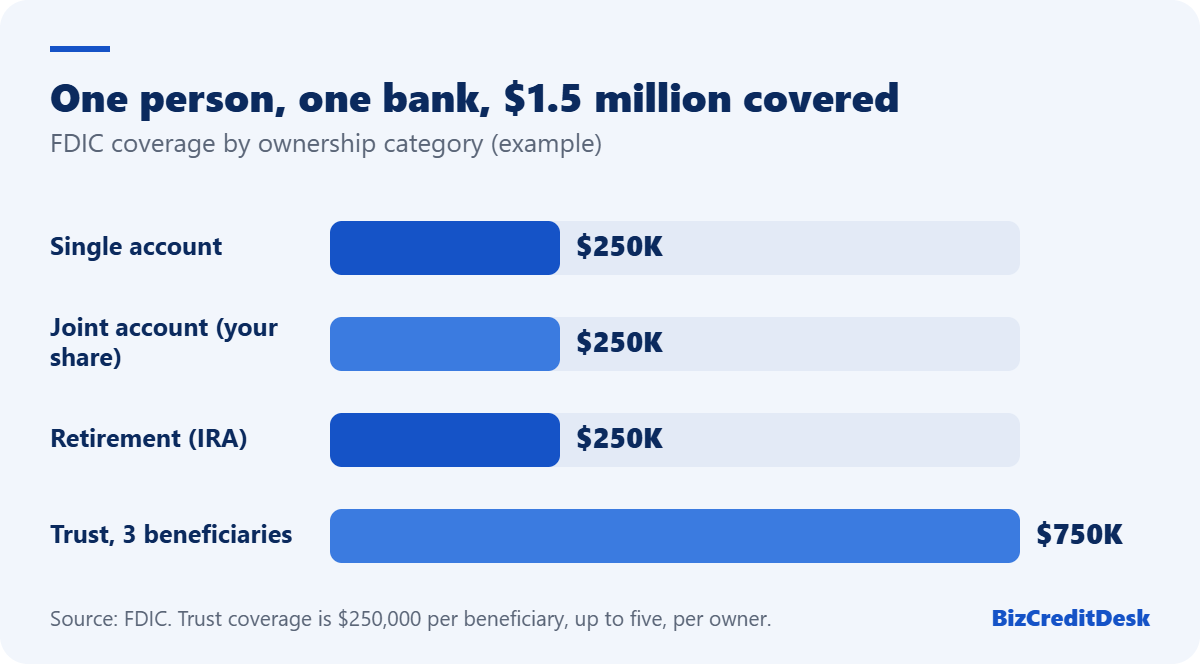
- It’s per ownership category. Accounts held in different legal categories are insured separately, even at the same bank.
How ownership categories multiply coverage
The main categories for individuals are single accounts, joint accounts, certain retirement accounts such as IRAs, and trust accounts. Each joint owner is insured up to $250,000 for their share of all joint accounts at the bank. Trust accounts are covered at $250,000 per eligible beneficiary, up to five beneficiaries, for each owner.
How to protect more than $250,000
- Use more than one bank. Coverage resets at each separately chartered bank. Be careful: some brands are part of the same bank charter.
- Use different ownership categories, such as a joint account or a payable-on-death beneficiary designation.
- Use a deposit placement network offered by many banks, which spreads large deposits across several insured institutions.
- Check your coverage with the FDIC’s free Electronic Deposit Insurance Estimator (EDIE).
Fintech apps and credit unions
Many apps say your money is “FDIC insured,” but the app itself is usually not a bank. Your deposits are only protected if they’re held at an insured partner bank and the records correctly show what belongs to you. Check the app’s disclosures and use the FDIC’s BankFind tool to confirm the partner bank. Credit unions are insured separately by the National Credit Union Administration (NCUA), which offers the same $250,000 standard coverage.
Why this matters when rates change
When rates are higher, as they are after the Fed’s September 2026 rate hike, savers often move money to high-yield accounts and CDs. Before you chase a higher APY, make sure the institution is insured and your total balance there stays within the limits. A healthy, insured emergency fund is the foundation of any financial plan.
Key takeaways
- FDIC insurance covers deposits up to $250,000 per depositor, per bank, per ownership category.
- Investments, crypto and safe deposit box contents are not covered.
- You can insure more than $250,000 by using multiple banks or ownership categories.
- Confirm that a fintech app’s partner bank is FDIC insured.