

Last updated: November 17, 2026
If your credit is thin or your income is too low to qualify for a personal loan on your own, a lender may suggest adding a second person to the application. That person can join as a co-signer or as a co-borrower (also called a joint applicant). The two sound alike, and both can help you get approved or land a lower rate, but they put the other person in very different positions.
The short version
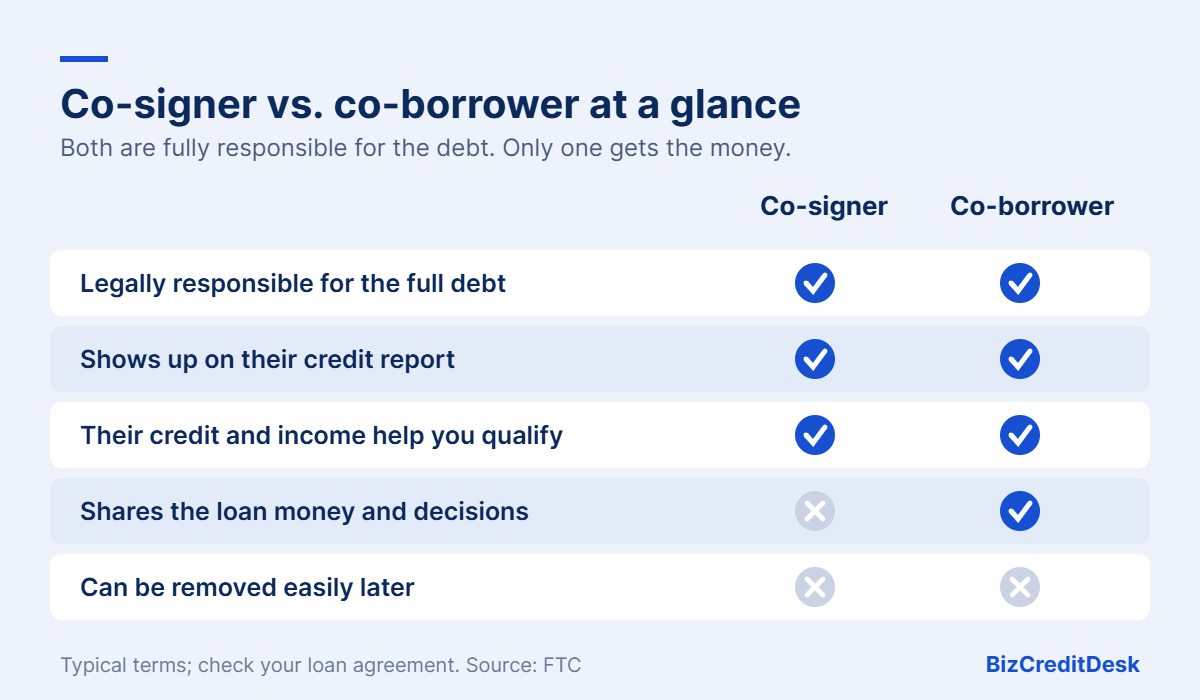
| Co-signer | Co-borrower (joint applicant) | |
|---|---|---|
| Role | Guarantees your loan | Borrows the money with you |
| Owns or uses the loan money | No | Yes, shared |
| Responsible for the full debt | Yes | Yes |
| Loan appears on their credit report | Yes | Yes |
| Typical use | A parent helping an adult child build credit | Spouses or partners borrowing for a shared expense |
What a co-signer does
A co-signer isn’t the main borrower but promises to repay the loan if you don’t. According to the Federal Trade Commission, a co-signer may have to pay the full amount owed plus late fees or collection costs, and gets no ownership of whatever the loan pays for (FTC).
Lenders look at the co-signer’s credit score and income when deciding whether to approve you and what rate to offer. That’s why a co-signer with strong credit can turn a decline into an approval or bring your rate down.
Before a co-signer signs, federal rules require most lenders to hand them a written Notice to Cosigner. It warns them, in plain language, that they are being asked to guarantee the debt and may have to pay it (FTC Credit Practices Rule, 16 CFR 444).
What a co-borrower does
A co-borrower applies with you as an equal. Both of your incomes and credit histories count, both of you sign, and both of you have a right to the money. Joint loans are common when two people share the expense, such as a couple consolidating debt or paying for a home repair.
Like a co-signer, a co-borrower is fully responsible for repaying the whole balance, not just half. If one of you stops paying, the lender can pursue the other for everything that’s owed.
How it affects everyone’s credit
- Hard inquiry: when you formally apply, the lender usually pulls credit for both people. Prequalifying first uses a soft check that doesn’t affect scores (see hard vs. soft inquiries).
- The debt counts as theirs too: the loan shows up on the other person’s credit report and adds to their debt load, which can make it harder for them to borrow later, even if every payment is on time (FTC).
- Late payments hurt both of you: a missed payment can appear on both credit reports. See what happens if you miss a loan payment.
- On-time payments help: a well-managed loan can build credit for the primary borrower, which is often the whole point.
Can you remove a co-signer or co-borrower later?
Usually not without replacing the loan. Some lenders offer a co-signer release after a run of on-time payments, but it’s uncommon, and the FTC notes lenders are unlikely to agree because it raises their risk. The most common route is to refinance into a new loan in your name alone once your credit and income can support it.
Which one makes sense?
- Choose a co-borrower if both of you need and will use the money, and both of you can afford the payment.
- Ask for a co-signer only if the money is for you alone and the other person can comfortably cover the payments if you can’t. It’s a serious favor, not a formality.
- Check the lender first: not every lender accepts co-signers or joint applications, so look for this when you compare loan offers.
If you’re the one being asked to co-sign
- Ask to see the borrower’s budget and make sure you could make the payments yourself.
- Ask the lender for the total amount you could owe if the borrower defaults.
- Ask for copies of monthly statements, or a written promise that the lender will tell you about missed payments.
- Check your credit reports regularly for free at AnnualCreditReport.com.
Alternatives to bringing in someone else
If you’d rather not put a friend or relative on the hook, consider a secured personal loan, a credit union loan, or a smaller loan you can qualify for alone. Our guides on getting a personal loan with bad credit and building credit from scratch cover more options.
Key takeaways
- A co-signer guarantees your loan; a co-borrower shares it with you.
- Both are legally responsible for the entire balance, and the loan shows on both credit reports.
- Only a co-borrower has a right to the loan money.
- Getting someone off a loan usually means refinancing, so treat the decision as long-term.
Sources
This article is for educational purposes only and is not financial advice. See our Disclaimer.