
Last updated: November 8, 2026
When you borrow, your loan will have either a fixed or a variable interest rate. A fixed rate stays the same for the life of the loan. A variable rate, sometimes called an adjustable rate, can rise or fall over time. The right choice depends on how long you’ll carry the debt, how much payment uncertainty you can handle and where you think rates are headed.
The short version
| Fixed rate | Variable rate | |
|---|---|---|
| Rate over time | Never changes | Moves with an index such as prime or SOFR |
| Monthly payment | Predictable | Can go up or down |
| Starting rate | Often a bit higher | Often a bit lower |
| Who carries the risk | The lender | You |
| Common examples | Most personal loans, auto loans, 30-year mortgages | Credit cards, HELOCs, adjustable-rate mortgages, some private student loans |
How fixed rates work
With a fixed rate, the lender locks in your rate when you sign. Your payment stays the same every month, which makes budgeting simple and protects you if rates rise. The trade-off is that you won’t benefit if rates fall unless you refinance, and the starting rate may be slightly higher because the lender is taking on the risk of future rate changes.
How variable rates work
A variable rate is made up of an index plus a margin. The index is a benchmark such as the prime rate or SOFR; the margin is a fixed number of percentage points set by your lender. When the index changes, your rate changes. Many loans include caps that limit how much the rate can rise at each adjustment or over the life of the loan, so read your agreement carefully.
What the difference can cost
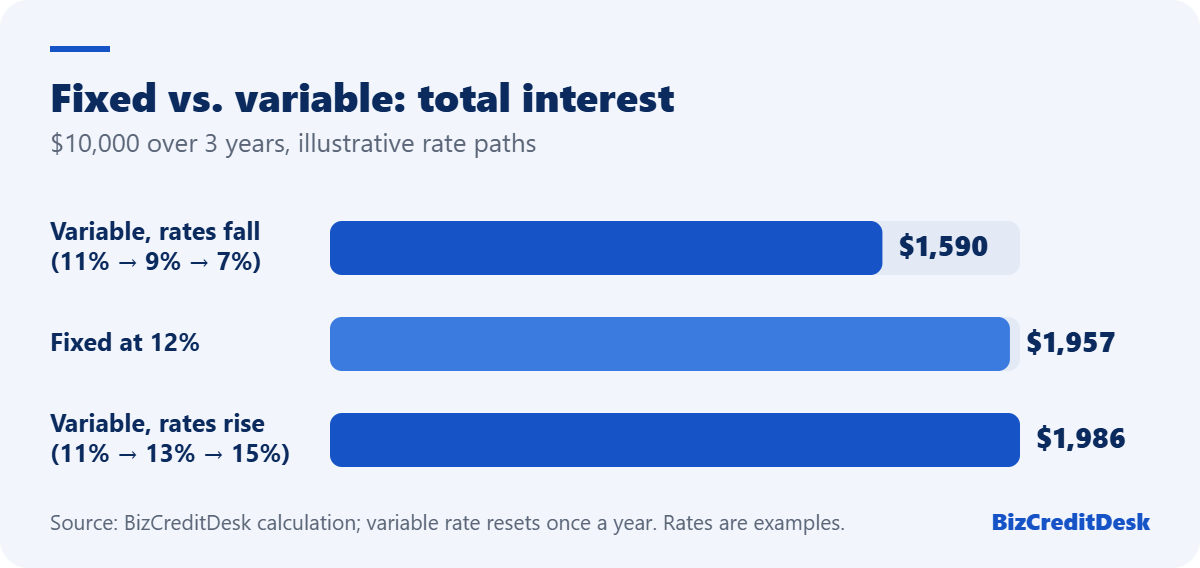
The example below compares a fixed 12% loan with a variable loan that starts at 11%. If rates fall, the variable loan costs about $367 less in interest. If rates rise by two points a year, it costs about $29 more, and the payment rises each year.
When a fixed rate makes sense
- You’ll carry the debt for several years.
- Your budget can’t absorb a higher payment.
- Rates are low or expected to rise. With the Fed having raised rates in September 2026 and inflation still above target, many borrowers value that certainty; see how Fed decisions affect your loans.
When a variable rate can make sense
- You plan to pay the debt off quickly, so there’s little time for rates to rise.
- The starting rate is meaningfully lower than fixed offers.
- The loan has strict rate caps and you could afford the maximum payment.
- You expect rates to fall.
Questions to ask before you sign
- What index is the rate tied to, and what is the margin?
- How often can the rate change?
- Are there caps on each adjustment and over the life of the loan?
- What would my payment be at the maximum rate?
- Can I switch to a fixed rate or refinance without a penalty?
Key takeaways
- Fixed rates offer predictable payments; variable rates offer a lower start but uncertainty.
- Variable rates equal an index plus a margin, so they move when benchmarks like prime move.
- The longer you carry a debt, the more a fixed rate protects you.
- Always calculate your payment at the highest rate the loan allows. Our guide on APR vs. APY explains how to compare loan costs.