
Last updated: November 17, 2026
When the Federal Reserve held its benchmark rate steady in October, many borrowers expected mortgage rates to stay put too. Instead, the rate that matters most for home loans moves with something else: the yield on the 10-year U.S. Treasury note. In mid-November 2026 that yield climbed back above 5%, its highest level in years. Here’s what Treasury yields are, why they move, and how they feed into the rates you pay.
Where rates stand now
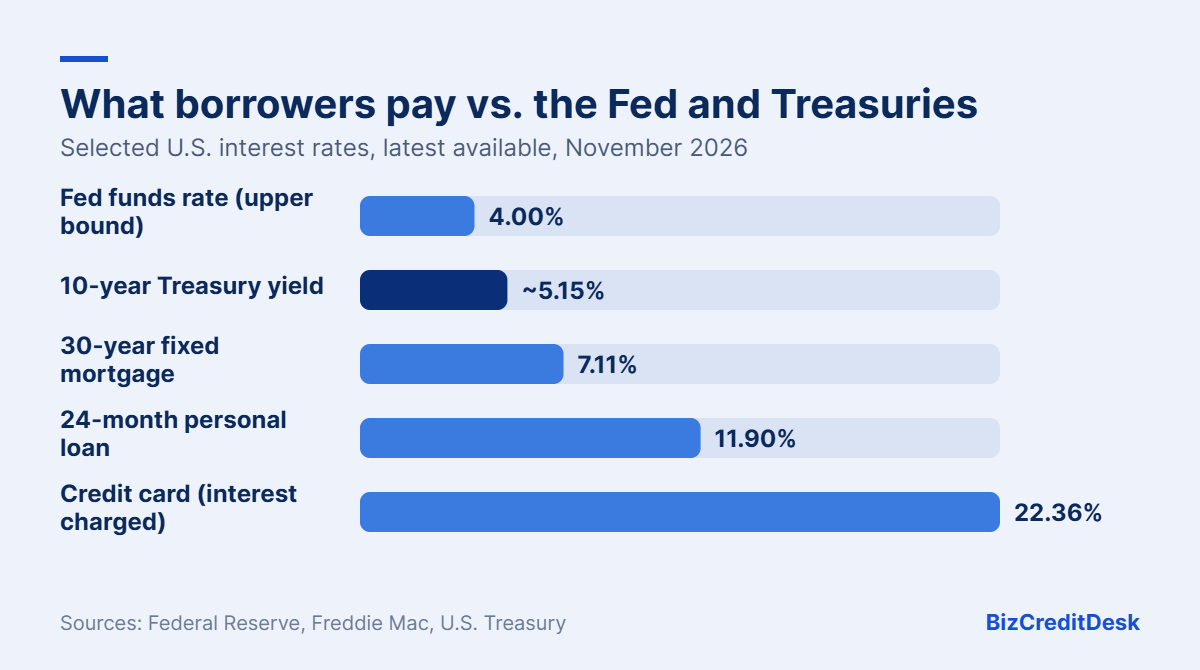
- 10-year Treasury yield: about 5.15% on November 13, 2026, roughly a full percentage point higher than a year earlier (U.S. Treasury).
- 30-year fixed mortgage: averaged 7.11% in Freddie Mac’s November 12 survey, down from 7.18% a week earlier but up from 6.24% a year ago (Freddie Mac).
- The Fed’s benchmark rate: held at 3.75% to 4.00% on October 28, 2026 (Federal Reserve). The next decision is due December 9.
What a Treasury yield is
When the U.S. government borrows money, it sells bonds called Treasuries. The yield is the annual return an investor earns for lending to the government at today’s market price. Because the U.S. government is considered the safest borrower in the world, Treasury yields act as the base rate for almost every other long-term loan in the economy. Lenders start from the Treasury yield and add a margin for risk, costs and profit.
Yields move every trading day. When investors sell Treasuries, prices fall and yields rise. When they buy, yields fall.
The Fed sets short rates; the market sets long rates
The Fed directly controls the federal funds rate, an overnight rate between banks (see how Fed rate decisions affect your loans). That rate quickly flows into the prime rate and into credit cards and other variable-rate debt.
The 10-year yield is different. It’s set by investors, and it reflects what they expect over the next decade:
- Inflation: if investors expect prices to keep rising, they demand a higher yield so inflation doesn’t eat their return. Consumer prices rose 3.7% in the 12 months to September 2026 (BLS), well above the Fed’s 2% goal.
- The Fed’s future path: if markets expect more rate hikes, long-term yields tend to rise ahead of them.
- Supply and risk: when the government borrows more, or when investors want extra compensation for tying up money for years, yields can climb even if the Fed does nothing.
That’s why mortgage rates can rise when the Fed is on hold, and fall before the Fed actually cuts.
How yields flow into the rates you pay
| Type of borrowing | Main benchmark | What to expect when the 10-year yield rises |
|---|---|---|
| 30-year fixed mortgage | 10-year Treasury yield plus a spread | New mortgage rates usually rise within days |
| Auto loans and fixed personal loans | Shorter Treasury yields and lenders’ funding costs, plus a credit premium | Rates drift up, but your credit profile matters more |
| Credit cards, HELOCs | Prime rate (tied to the Fed) | Little direct effect; they move with the Fed |
| Savings, CDs | Fed rate and Treasury yields | Longer CDs may pay more |
Mortgage rates typically sit well above the 10-year yield. Right now the gap is roughly two percentage points (7.11% vs. about 5.1%). That spread covers the lender’s risk that you’ll refinance or prepay early, plus servicing costs and profit.
What a higher yield costs a homebuyer
On a $300,000, 30-year fixed mortgage, the monthly principal and interest payment is about $1,845 at 6.24% (a year ago) and about $2,018 at 7.11% (today). That’s roughly $173 more per month, or about $62,000 more over 30 years if the loan is kept to term.
Already have a fixed-rate mortgage or fixed-rate personal loan? Your rate doesn’t change when yields move. Rising yields affect new borrowing, not loans you’ve already locked in.
What you can do
- Shop for rates the same week. Because yields move daily, compare offers obtained at about the same time. Our guide on how to compare loan offers shows what to line up.
- Lock when the payment works for you. Trying to time the bond market is guesswork, even for professionals.
- Improve the part you control. Your credit score and debt-to-income ratio decide how much lenders add on top of the benchmark. See how credit scores are calculated.
- Pay down variable-rate debt first. Credit card rates averaged 22.36% on accounts charged interest in Q3 2026 (Federal Reserve), far above any Treasury yield.
Key takeaways
- The 10-year Treasury yield is the main benchmark for 30-year mortgage rates, not the Fed’s rate.
- Yields rise when investors expect higher inflation, more Fed hikes or more government borrowing.
- Mortgage rates usually run about 1.5 to 3 percentage points above the 10-year yield.
- Rising yields affect new loans; existing fixed-rate loans don’t change.
Sources
- Freddie Mac, Primary Mortgage Market Survey (November 12, 2026)
- U.S. Department of the Treasury, Interest rate data
- Federal Reserve, H.15 Selected Interest Rates
- Federal Reserve, FOMC statement (October 28, 2026)
- Federal Reserve, G.19 Consumer Credit
- U.S. Bureau of Labor Statistics, Consumer Price Index
This article is for educational purposes only and is not financial advice. See our Disclaimer.