
Last updated: November 17, 2026
When you prequalify with a few lenders, you usually get back a handful of offers that look similar at first glance: a rate, a term, a monthly payment and maybe a fee. Picking the one with the lowest interest rate feels like the obvious move, but it isn’t always the cheapest. This guide shows you exactly what to line up side by side, with a worked example of three real-looking offers.
The short version
| Compare this | Why it matters |
|---|---|
| APR | Combines the interest rate and upfront fees into one yearly figure. It’s the fairest single number for comparing loans of the same length. |
| Total cost | All interest and fees over the life of the loan. The real price tag. |
| Monthly payment | What has to fit in your budget every month. |
| Term | A longer term lowers the payment but usually raises the total cost. |
| Fees and fine print | Origination fees, late fees and any prepayment penalty. |
Step 1: Get offers without hurting your credit
Most online lenders and many banks and credit unions let you prequalify. They run a soft credit check, which doesn’t affect your score, and show you an estimated rate and terms. Only when you formally apply does the lender run a hard inquiry. Read more in our guide to hard vs. soft credit inquiries.
One detail many borrowers miss: credit scoring models group several mortgage, auto or student loan inquiries made within a short window and count them as one, but that grouping generally doesn’t apply to personal loans. So prequalify with as many lenders as you like, then formally apply only with the one you choose.
Step 2: Compare APR, not just the interest rate
The interest rate tells you what you pay to borrow the money. The APR adds in upfront costs such as an origination fee, so it reflects the full yearly cost of the loan (CFPB). Under the Truth in Lending Act, lenders have to show you the APR, the finance charge and the total of payments before you sign.
For context, the average rate on a 24-month personal loan at commercial banks was 11.90% in the third quarter of 2026, according to the Federal Reserve (G.19). Your offers may be higher or lower depending on your credit score, income and existing debt.
Step 3: Watch how the origination fee is charged
Origination fees are usually a percentage of the loan and are often deducted from the money you receive. Borrow $10,000 with a 6% fee and only $9,400 lands in your account, but you repay the full $10,000 plus interest. If you need exactly $10,000, you’d have to borrow about $10,640.
Step 4: Calculate the total cost
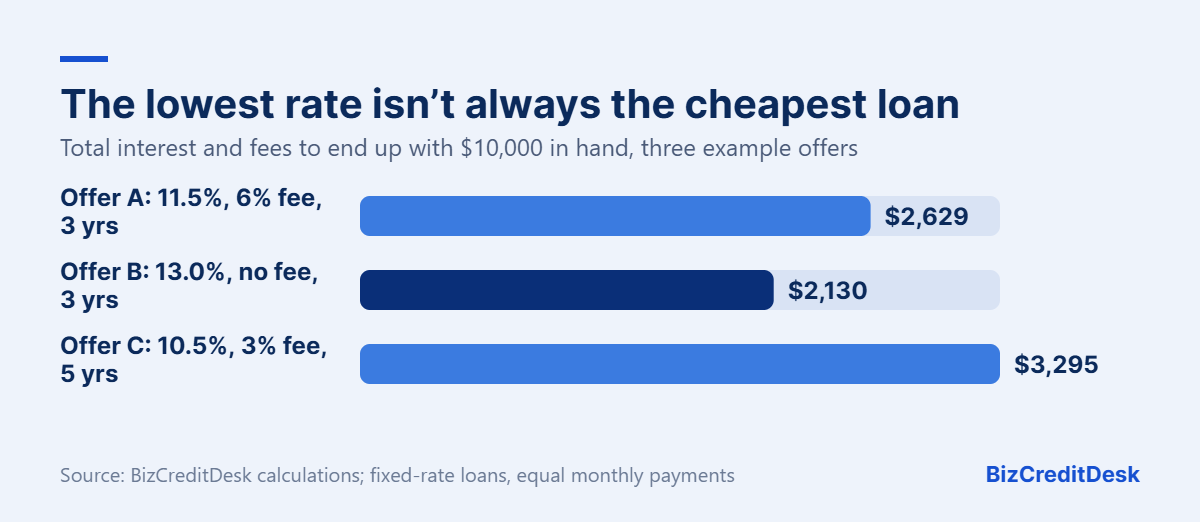
Here’s where the numbers can surprise you. Imagine you need $10,000 in hand and you receive these three offers. To compare fairly, each loan amount below is sized so you receive $10,000 after the fee.
| Offer A | Offer B | Offer C | |
|---|---|---|---|
| Interest rate | 11.5% | 13.0% | 10.5% |
| Origination fee | 6% | None | 3% |
| Term | 36 months | 36 months | 60 months |
| Amount borrowed | $10,638 | $10,000 | $10,309 |
| APR | 15.84% | 13.00% | 11.83% |
| Monthly payment | $350.80 | $336.94 | $221.58 |
| Total interest and fees | $2,629 | $2,130 | $3,295 |
Offer A has a lower rate than Offer B, but the 6% fee makes it more expensive. Offer C has the lowest APR and by far the lowest payment, yet it costs the most in total because you pay interest for two extra years. Offer B, with the highest interest rate, is the cheapest loan.
Notice that APR is the best quick filter only when terms are the same length. When terms differ, check the total cost too.
Step 5: Make sure the payment fits
The cheapest loan is only a good deal if you can make every payment on time. A missed payment can mean late fees and a hit to your credit (see what happens if you miss a loan payment). If Offer B’s payment is too tight, a longer term might be the safer choice even though it costs more, as long as you go in knowing the trade-off.
Step 6: Read the fine print
- Prepayment penalty: can you pay the loan off early for free? Most personal loans allow it, but check.
- Rate discounts: some lenders take a little off the rate for autopay or for paying your creditors directly on a debt consolidation loan. Make sure the offer you’re comparing includes or excludes the discount consistently.
- Late and returned-payment fees: they vary by lender.
- Funding time: some lenders fund the next business day, others take a week.
- Fixed vs. variable rate: most personal loans are fixed, which keeps your payment steady. See fixed vs. variable interest rates.
Red flags to walk away from
A legitimate lender never asks you to pay a fee before you receive the loan, and never “guarantees” approval without looking at your credit. If an offer looks too good or the lender pressures you to decide today, check our guide to personal loan scam warning signs.
Key takeaways
- Prequalify with several lenders using soft checks, then formally apply with just one.
- Compare APR for loans of the same length, and total cost for loans of different lengths.
- An origination fee is often deducted from the money you receive, so borrow enough to cover it or pick a no-fee loan.
- The lowest monthly payment usually means the highest total cost.
Sources
- Federal Reserve, G.19 Consumer Credit (released November 6, 2026)
- CFPB, What is the difference between a loan interest rate and the APR?
- CFPB, Regulation Z (Truth in Lending)
- Example figures: BizCreditDesk calculations for fixed-rate loans with equal monthly payments.
This article is for educational purposes only and is not financial advice. See our Disclaimer.