
Last updated: November 1, 2026
If you’ve decided to consolidate your credit card debt, the two most popular tools are a debt consolidation loan and a balance transfer credit card. Both can cut your interest costs dramatically compared with leaving balances on high-rate cards. But they work very differently, and the better choice depends on how much you owe, your credit and, above all, how fast you can pay it off.
The quick answer
- Choose a balance transfer card if you have good credit and can realistically pay off the whole balance before the 0% promotional period ends.
- Choose a consolidation loan if you need more time, want a fixed payment and a guaranteed end date, or owe more than a card’s credit limit would allow.
How each option works
Balance transfer card
You open a new card that offers a low or 0% introductory rate on transferred balances for a set period, then move your existing card debt onto it. Most cards charge a balance transfer fee, typically 3% to 5% of the amount moved, and the fee is added to your balance (Experian). The CFPB confirms that issuers may charge this fee even on a 0% offer (CFPB).
When the promotion ends, any remaining balance starts accruing interest at the card’s regular rate. For reference, the average rate on credit card accounts charged interest was 22.36% in August 2026 (Federal Reserve G.19).
Debt consolidation loan
You take out a personal loan, use it to pay off your cards and repay the loan in fixed monthly installments over a set term, usually two to five years. The average rate on a 24-month personal loan at commercial banks was 11.90% in August 2026 (Federal Reserve G.19). Some lenders charge an origination fee, which may be deducted from the loan amount.
Side-by-side comparison
| Balance transfer card | Consolidation loan | |
|---|---|---|
| Interest rate | Often 0% for an intro period, then the card’s regular APR | Fixed APR for the whole term (usually) |
| Upfront cost | Transfer fee, typically 3%–5% | Origination fee with some lenders |
| Payment | Flexible minimum payment | Fixed monthly installment |
| Payoff date | None built in | Set by the loan term |
| How much you can move | Limited by the card’s credit limit | Often larger amounts |
| Credit needed | Usually good to excellent for the best offers | Wider range, but rates rise as credit weakens |
| Biggest risk | Balance left when the promo ends | Long terms raise total interest |
Real numbers: $8,000 of credit card debt
Let’s compare the options for $8,000 of card debt. Assumptions: an 18-month 0% balance transfer offer with a 3% fee, a regular card rate of 22.36% after the promotion, and a consolidation loan at 11.90% with no origination fee.
Scenario 1: You can pay about $460 a month
| Option | Monthly payment | Time to pay off | Total cost of borrowing |
|---|---|---|---|
| Balance transfer (0% for 18 months, 3% fee) | $458 | 18 months | $240 (the fee) |
| Consolidation loan, 24 months at 11.90% | $376 | 24 months | $1,029 in interest |
If you can clear the balance within the promotion, the balance transfer is the clear winner, costing about $790 less than the loan.
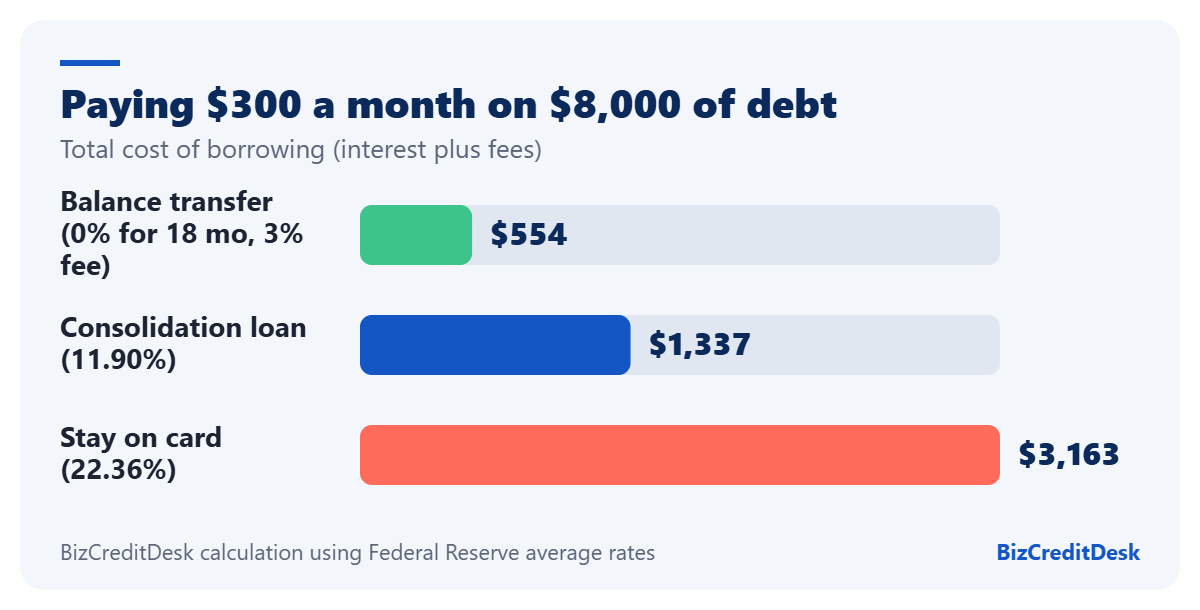
Scenario 2: You can only pay $300 a month
| Option | Time to pay off | Total cost of borrowing |
|---|---|---|
| Balance transfer (then 22.36% on what’s left) | 29 months | About $554 ($240 fee + $314 interest) |
| Consolidation loan at 11.90% | 32 months | About $1,337 in interest |
| Keep the debt on a 22.36% card | 38 months | About $3,163 in interest |
Even when you can’t finish within the promo period, the balance transfer still comes out ahead in this example, because 18 months at 0% does a lot of the work. Both options beat doing nothing by a wide margin.
So why would anyone choose the loan? Because the math above assumes perfect behavior: no new spending on the card, no late payments and a regular rate no higher than average. The CFPB warns that new purchases on a balance transfer card may not get a grace period and that paying more than 60 days late can let the issuer raise the rate on your entire balance (CFPB). A loan’s fixed payment and end date remove much of that risk.
When a balance transfer card is the better choice
- Your credit is good enough to qualify for a long 0% offer.
- Your debt fits within the new card’s credit limit.
- You can pay off all or most of the balance before the promotion ends.
- You’re confident you won’t add new purchases to the card.
When a consolidation loan is the better choice
- You owe more than a balance transfer card would let you move.
- You need several years to pay off the debt.
- You want a fixed payment that won’t change and a firm payoff date.
- You know an open credit line would tempt you to keep spending.
How each option affects your credit
Both involve a hard inquiry and a new account, which can cause a small, temporary dip. After that, the effects differ:
- Balance transfer: moving all your debt onto one card can leave that card nearly maxed out, which can weigh on your score until you pay it down.
- Consolidation loan: paying off your cards with an installment loan usually lowers your credit card utilization, which can help your score more quickly.
Learn more about how scoring works in our guide on what credit score you need for a personal loan.
Tips for whichever you choose
- Calculate the payment needed to finish within the promo period or loan term, and set up autopay for it.
- Include all fees when comparing offers, not just the rate.
- Read the card’s terms for the promo length, the regular APR and the fee before transferring.
- Don’t run up new balances on the cards you’ve paid off.
- If you can’t find a good offer, a nonprofit credit counselor can review your options for free.
Key takeaways
- A balance transfer card is usually cheapest if you can pay the debt off during the 0% period.
- A consolidation loan offers a fixed payment, a set end date and room for larger balances.
- Balance transfer fees typically run 3% to 5%, and loans may carry origination fees.
- Either option only works if you stop adding new debt.
Sources
This article is for educational purposes only and is not financial advice. Card offers, rates and fees change frequently; always confirm current terms with the issuer or lender. See our Disclaimer.