
Last updated: November 20, 2026
Before a lender approves a personal loan, it wants to know two things: how you’ve handled credit in the past, and whether you can afford one more monthly payment. Your credit score answers the first question. Your debt-to-income ratio (DTI) answers the second. Here’s how to work it out in a couple of minutes, what counts as too high, and how to bring it down before you apply.
The short version
| Debt-to-income ratio (DTI) | |
|---|---|
| What it measures | The share of your gross monthly income that goes to debt payments |
| Formula | Monthly debt payments ÷ gross monthly income × 100 |
| Counts | Loan payments, minimum credit card payments, mortgage, child support or alimony |
| Doesn’t count | Groceries, utilities, insurance, phone and other living costs |
| CFPB guideline | 36% or less for homeowners; 15% to 20% for renters |
| Affects your credit score? | No. Your income isn’t part of your credit report |
How to calculate your DTI
You only need two numbers: what you pay toward debts each month and what you earn before taxes.
- Add up your monthly debt payments. Use the required payment on each account, such as the minimum due on a credit card, not the amount you choose to pay.
- Find your gross monthly income. That’s your pay before taxes and deductions. If your income changes from month to month, the Consumer Financial Protection Bureau (CFPB) suggests estimating a typical month.
- Divide the first number by the second and multiply by 100 to get a percentage.
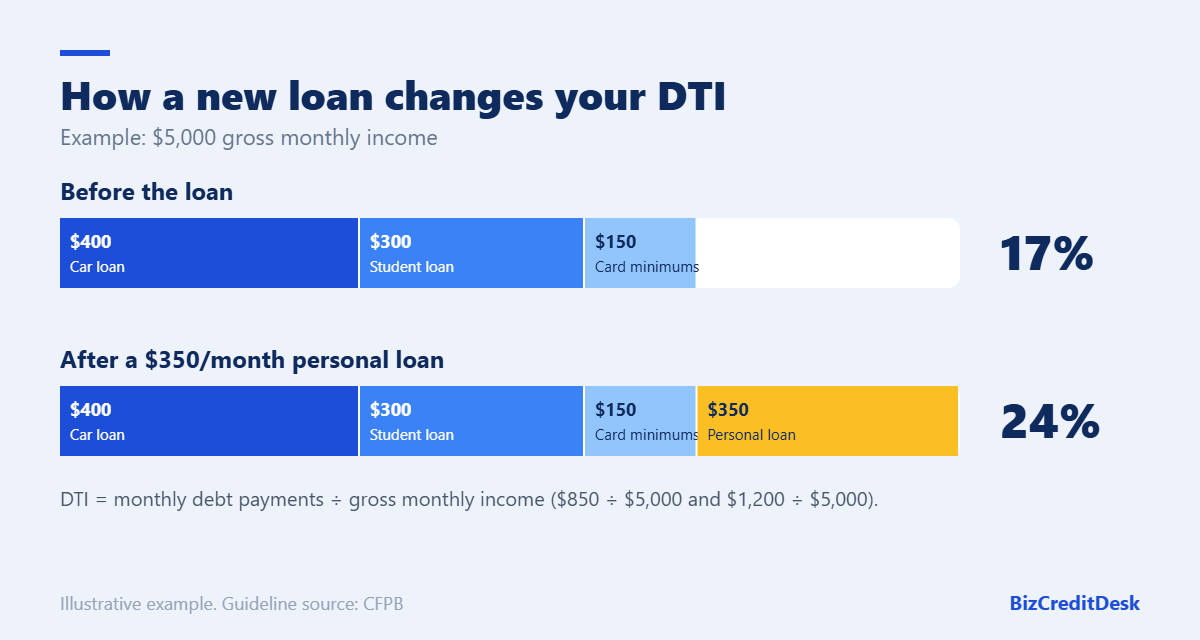
Example: Maria earns $5,000 a month before taxes. She pays $400 on a car loan, $300 on student loans and $150 in credit card minimums, a total of $850. Her DTI is $850 ÷ $5,000 = 17%. If she takes a personal loan with a $350 monthly payment, her debt payments rise to $1,200 and her DTI to 24%.
Lenders care about that second number: your DTI after the new loan. Our guide on how personal loan interest rates work explains how the rate and term set that payment.
What counts as debt, and what doesn’t
DTI only includes payments you’re legally required to make on debts. Typical items:
- Personal, auto and student loan payments
- Minimum payments on credit cards
- Mortgage or home equity payments, including property taxes and insurance when they’re part of the payment
- Child support and alimony
Everyday expenses such as food, utilities, phone bills, car insurance and streaming services are left out, even though they come out of the same paycheck. In the CFPB’s guidance, rent isn’t counted either, which is why it suggests a lower target for renters. Some lenders still ask about your housing costs separately, so read each application carefully.
What’s a good debt-to-income ratio?
There’s no single cutoff. Different loan products and lenders set their own limits. The CFPB offers a general guideline:
- Homeowners: keep DTI at 36% or less, mortgage payment included.
- Renters: aim for 15% to 20%, since rent isn’t part of the calculation.
You may also have heard of a 43% limit. That figure came from the CFPB’s original Qualified Mortgage rule for home loans, which was later revised to rely on loan pricing instead of a fixed DTI cap. Mortgage lenders still review your DTI closely. Personal loan lenders publish their own requirements, and a lower ratio generally gives you more options and better offers.
How your DTI affects a personal loan
A high DTI tells a lender that a big share of your income is already spoken for. That can mean a smaller loan amount, a higher rate or a denial, even if your credit score is good. A low DTI works in your favor when you compare personal loan offers.
DTI isn’t the same as credit utilization. Utilization compares your card balances with your credit limits and directly affects your score. DTI compares payments with income and doesn’t appear on your credit report, so lenders calculate it from your application and income documents.
How to lower your DTI before you apply
- Pay off a small balance completely. Clearing a loan or card removes its whole payment from the calculation.
- Avoid new debt. A new car loan or store card right before you apply adds another payment.
- Include all your income. Regular, documented income from a second job or freelance work may count. Ask the lender what proof it accepts.
- Apply with someone else. A co-borrower’s income counts, but so do their debts. Read co-signer vs. co-borrower first.
- Be careful with longer terms. Debt consolidation over a longer term can shrink your monthly payment, but you may pay more interest overall.
Key takeaways
- DTI is your monthly debt payments divided by your gross monthly income.
- Lenders use it to judge whether you can afford a new payment. It doesn’t affect your credit score.
- The CFPB suggests 36% or less for homeowners and 15% to 20% for renters, but each lender sets its own limit.
- Paying off small balances and avoiding new debt are the quickest ways to lower it.
Sources
This article is for educational purposes only and is not financial advice. See our Disclaimer.