
Last updated: November 1, 2026
The interest rate is the single biggest factor in what a personal loan really costs you. Yet loan offers throw around terms like “rate,” “APR,” “fixed” and “origination fee” that can make two offers hard to compare. This guide explains how personal loan interest works, how lenders set your rate and how to make sure you’re comparing offers fairly.
Interest rate vs. APR: what’s the difference?
The interest rate is the cost of borrowing the principal, expressed as a percentage. The APR (annual percentage rate) includes the interest rate plus certain lender fees, such as origination charges. Under the Truth in Lending Act, lenders must disclose the APR, which makes it the better number for comparing offers. The CFPB’s advice: compare APRs to APRs, not APRs to interest rates (CFPB).
Example: a $10,000, 36-month loan at an 11.90% interest rate with a 5% origination fee deducted up front means you receive $9,500 but repay based on $10,000. That pushes the effective APR to about 15.5%.
Fixed vs. variable rates
| Fixed rate | Variable rate | |
|---|---|---|
| How it works | Stays the same for the whole loan | Moves with a benchmark rate |
| Monthly payment | Predictable | Can rise or fall |
| Best when | Rates may rise, or you want certainty | Rates are expected to fall and you can handle changes |
| How common | Most personal loans | Less common for personal loans |
To see why this matters: on a $10,000, 36-month loan, a rate two points higher (13.90% instead of 11.90%) raises the monthly payment from about $332 to $341 and the total interest from about $1,940 to $2,286.
How personal loan interest is calculated
Most personal loans use simple interest on an amortizing schedule. Each month, interest is calculated on the balance you still owe, and the rest of your fixed payment goes toward the principal. Because the balance is highest at the start, early payments are mostly interest, and later payments are mostly principal.
For a $10,000 loan at 11.90% over 36 months (payment of about $332):
- Month 1: about $99 goes to interest and $233 to principal.
- Year 1: about $1,033 in interest.
- Year 2: about $662 in interest.
- Year 3: about $245 in interest.
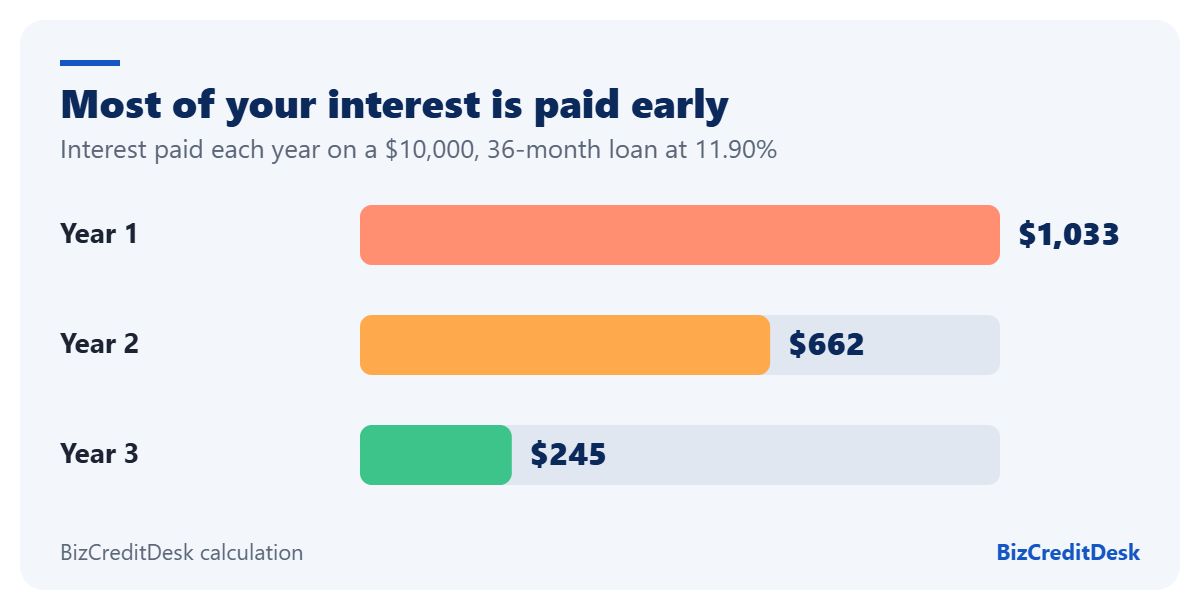
This is why extra payments early in the loan save the most money, as long as your lender doesn’t charge a prepayment penalty.
What determines the rate you’re offered
- Your credit score and history. This is the biggest factor. See what credit score you need for a personal loan.
- Your income and debt-to-income ratio. Lower existing debt relative to income usually means a better rate.
- Loan amount and term. Longer terms often carry higher rates and always mean more total interest.
- The lender. Banks, credit unions and online lenders price risk differently.
- Collateral or a cosigner. Secured loans or a creditworthy cosigner can lower your rate.
- The overall rate environment. When the Federal Reserve raises its benchmark rate, lenders’ costs rise too. Read how inflation affects your loans and credit cards.
What’s a good personal loan rate right now?
The average rate on a 24-month personal loan at commercial banks was 11.90% in August 2026, compared with 22.36% on credit card accounts charged interest (Federal Reserve G.19). An offer meaningfully below the bank average is generally competitive; one far above it deserves a closer look, especially if fees are involved.
How to get a lower rate
- Improve your credit first by paying down card balances and making every payment on time.
- Prequalify with several lenders using soft credit checks.
- Choose the shortest term you can afford.
- Ask about discounts for autopay or for existing customers.
- Consider a credit union, which may offer competitive rates to members.
Our step-by-step personal loan guide walks through the full process.
Key takeaways
- Compare loans by APR, which includes fees, not by the interest rate alone.
- Most personal loans have fixed rates and fixed payments.
- Early payments are mostly interest, so extra payments early save the most.
- Your credit, income, loan term and the lender all shape your rate.
Sources
This article is for educational purposes only and is not financial advice. Rates and terms change frequently; always confirm current terms with the lender. See our Disclaimer.