
Last updated: November 1, 2026
Debt consolidation can save you a lot of money in interest, but many people hesitate because they’re worried it will damage their credit score. The short answer: consolidation usually causes a small, temporary dip, and then often helps your score over the following months, as long as you make your payments on time and don’t run your cards back up. Here’s exactly what happens to your credit at each stage.
The short version
| Stage | What happens | Typical effect on your score |
|---|---|---|
| You apply | Hard inquiry on your credit report | Small, temporary drop |
| The new account opens | Average age of your accounts goes down | Small drop for some people |
| Your cards are paid off | Credit card utilization falls | Often a meaningful boost |
| Months of on-time payments | Positive payment history builds | Steady improvement |
1. The hard inquiry: a small, short-lived hit
When you formally apply for a personal loan or a balance transfer card, the lender pulls your credit, creating a hard inquiry. According to FICO, for most people one additional inquiry takes less than five points off their FICO scores, though the effect can be larger if you have few accounts or a short credit history (myFICO).
Inquiries can stay on your report for up to two years, but FICO scores only consider them for 12 months (myFICO). Experian notes that scores typically recover within a few months if the rest of your history is positive (Experian).
How to minimize it: prequalify with soft credit checks, which don’t affect your score, and only submit a full application to the lender you choose.
2. A new account: slightly younger credit history
Length of credit history makes up about 15% of your FICO score, and new credit about 10% (myFICO). Opening a new loan or card lowers the average age of your accounts, which can shave off a few points. If you already have a long credit history, the effect is usually minor.
3. Paying off your cards: where your score can jump
This is the big one. “Amounts owed,” which includes how much of your available credit card limits you’re using, accounts for about 30% of your FICO score (myFICO). This ratio is called your credit utilization.
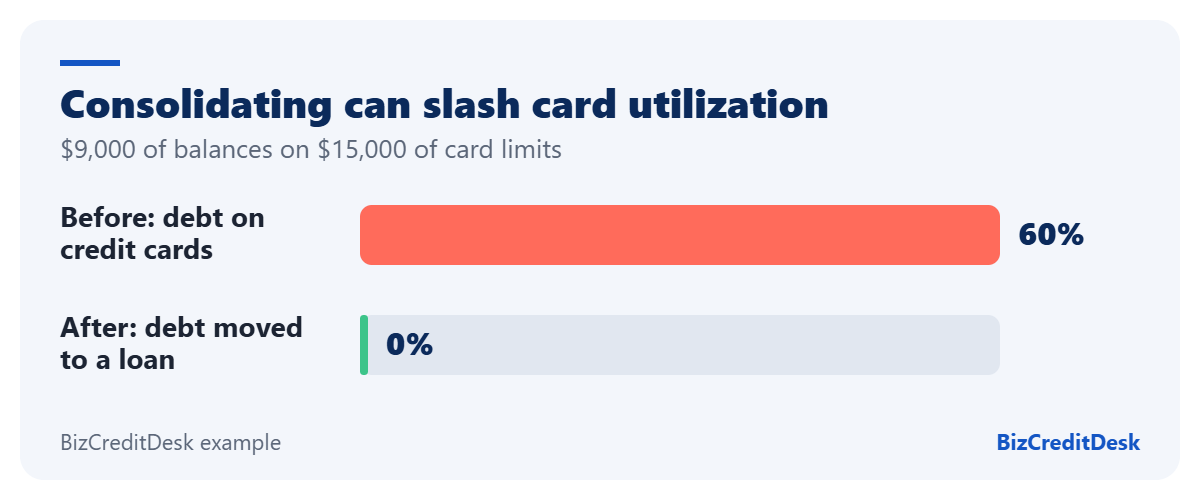
Here’s an example. Say you have three cards with a combined limit of $15,000 and balances totaling $9,000:
- Before consolidating: $9,000 ÷ $15,000 = 60% utilization.
- After paying the cards off with a consolidation loan: $0 ÷ $15,000 = 0% card utilization.
You still owe the same $9,000, but now it’s on an installment loan rather than on revolving credit cards, and scoring models treat those differently. High card balances tend to hurt your score more, so moving the debt to a loan often helps. Lower utilization is better, and many experts use 30% as a rough upper guideline.
What about a balance transfer card?
A balance transfer works differently. Your old cards drop to zero, but the new card may end up close to its limit. Overall utilization across all your cards may improve, yet the single maxed-out card can still weigh on your score until you pay it down. Our comparison of consolidation loans vs. balance transfer cards covers this in more detail.
4. On-time payments: the long-term win
Payment history is the single largest factor in your FICO score, at about 35% (myFICO). One fixed payment is easier to manage than several due dates, and every on-time payment adds to a positive record. Set up autopay so you never miss one.
When debt consolidation can hurt your credit
- You miss payments on the new loan. Late payments can stay on your credit report for up to seven years (CFPB).
- You run your cards back up. Then you have the loan and new card debt, with higher utilization than before.
- You apply with many lenders at once. Several hard inquiries add up.
- You close your oldest cards. That can raise your utilization and shorten your credit history.
- You confuse consolidation with debt settlement. Settlement programs that tell you to stop paying creditors can seriously damage your credit (CFPB).
Should you close your cards after consolidating?
Usually not. Keeping paid-off cards open preserves your available credit, which keeps your utilization low, and protects the age of your accounts. Exceptions: a card with an annual fee you don’t want to pay, or a card you know you’ll be tempted to use. If you keep them, consider storing them away or using one for a small recurring bill you pay in full each month.
A realistic timeline
- Weeks 0–4: a small dip from the inquiry and new account.
- Next statement cycle: card balances are reported as paid off; utilization falls and your score may rise.
- Months 3–12: on-time payments build positive history; the inquiry’s effect fades.
- After 12 months: FICO no longer counts the inquiry at all.
Every credit file is different, so treat this as a general pattern rather than a guarantee.
Key takeaways
- Expect a small, temporary drop from the hard inquiry and new account.
- Paying off credit cards lowers your utilization, which often boosts your score.
- On-time payments on the new loan are what improve your credit over time.
- Avoid running up the old cards again and think twice before closing them.
Sources
- myFICO, What’s in my FICO Scores?
- myFICO, Credit inquiries and your score
- myFICO, How to rate shop and minimize the impact to your FICO Scores
- Experian, How many points does an inquiry drop your credit score?
- CFPB, How long does information stay on my credit report?
- CFPB, What do I need to know about consolidating my credit card debt?
This article is for educational purposes only and is not financial advice. Credit scoring varies by model and individual credit file. See our Disclaimer.