
Last updated: November 17, 2026
Every few weeks, headlines announce that the Federal Reserve raised, cut or held interest rates. The Fed doesn’t set the rate on your credit card or car loan directly, but its decisions ripple through to almost every kind of borrowing and saving. Here’s how that works and what the latest decisions mean for you.
Where rates stand now
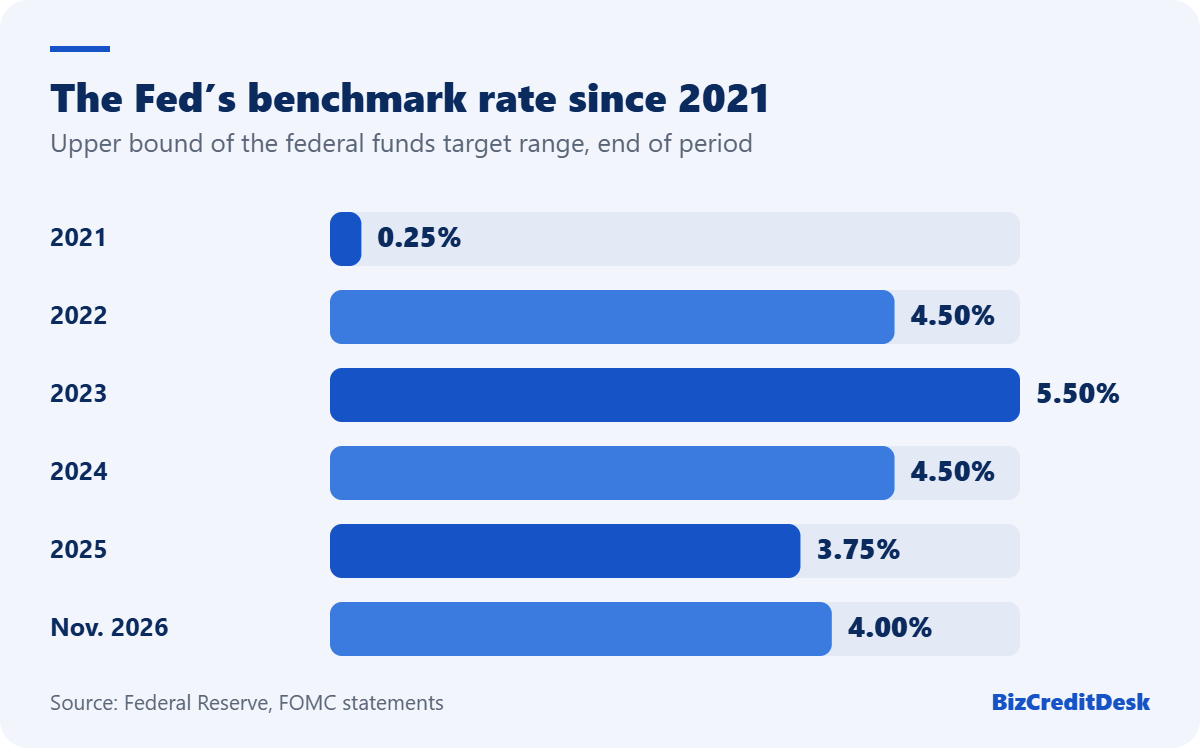
On September 16, 2026, the Fed’s Federal Open Market Committee (FOMC) raised its benchmark rate by a quarter point, its first increase since 2023, to a target range of 3.75% to 4.00%. At its October 28 meeting the committee held the rate steady in a 10–2 vote; the two dissenters wanted another quarter-point increase. The statement noted that inflation remains elevated above the Fed’s 2% goal.
The committee’s next meeting is December 8–9, 2026, with the decision announced on December 9 (Federal Reserve).
The short version
| Product | How quickly it reacts to the Fed | Why |
|---|---|---|
| Credit cards | Within one or two billing cycles | Most card APRs are variable and tied to the prime rate |
| HELOCs | Within one or two billing cycles | Usually priced as prime plus a margin |
| New personal loans | Gradually | Lenders adjust offers as their funding costs change |
| Existing fixed-rate loans | Not at all | Your rate is locked for the life of the loan |
| Mortgages | Indirectly | Follow longer-term Treasury yields more than the Fed |
| Savings and CDs | Gradually, and unevenly | Banks decide when to pass changes on to savers |
What the Fed actually controls
The FOMC sets a target range for the federal funds rate, the rate banks charge each other for overnight loans. It meets eight times a year. Banks base their prime rate on this target, typically setting prime 3 percentage points above the upper end of the range. With the range at 3.75% to 4.00%, prime is 7.00%.
Credit cards feel it first
Most credit cards carry a variable APR equal to prime plus a margin. When the Fed raised rates in September, cardholders with variable rates generally saw their APR rise by about 0.25 percentage points within a couple of statements. The Federal Reserve’s G.19 data shows the average rate on card accounts that pay interest was 22.36% in August 2026. A quarter-point change sounds small, but on a large balance carried for years it adds up. If you carry a balance, paying it down or moving it to a balance transfer card or consolidation loan matters more than any single Fed decision.
Personal loans and mortgages
Most personal loans have fixed rates, so a Fed move doesn’t change the loan you already have. It can change the offers you get on a new loan, because lenders’ own borrowing costs shift. Mortgage rates follow the 10-year Treasury yield, which reflects expectations about inflation and future Fed policy, so they can move before, after or even in the opposite direction from a Fed decision.
Mortgage rates in particular follow the 10-year Treasury yield more closely than the Fed itself. Our guide to how Treasury yields affect your mortgage and loan rates explains why.
Savings: the upside of higher rates
Higher rates mean better yields on high-yield savings accounts, money market accounts and CDs. Banks are often quick to raise loan rates and slower to raise savings rates, so it pays to compare the APY on your account with what online banks and credit unions offer.
What to do now
- Pay down variable-rate debt, starting with the highest APR.
- If you’re shopping for a loan, compare several offers; small rate differences add up.
- Consider locking in a fixed rate if you expect rates to keep rising.
- Move idle cash to an insured account that pays a competitive yield.
Key takeaways
- The federal funds target range is 3.75% to 4.00% after the September 2026 hike and the October hold.
- Credit cards and HELOCs react fastest because they’re tied to the prime rate.
- Existing fixed-rate loans don’t change when the Fed moves.
- Higher rates hurt borrowers but help savers who shop for a good yield.