
Last updated: November 8, 2026
If you read the fine print on a credit card agreement or a home equity line of credit, you’ll probably see your rate described as “prime plus” some number. The prime rate is one of the most important numbers in consumer lending, yet few borrowers know what it is or why it changes.
The short version
| Details | |
|---|---|
| Current U.S. prime rate | 7.00% (since September 2026) |
| How it’s set | Banks set it, usually at the Fed’s target rate + 3 percentage points |
| When it changes | Typically the day after the Fed changes its target range |
| Products tied to it | Variable-rate credit cards, HELOCs, some personal and business loans |
| Products not tied to it | Fixed-rate loans and most mortgages |
What is the prime rate?
The prime rate is the interest rate banks use as a starting point for pricing many loans. Historically it was the rate banks offered their most creditworthy business customers. Today it’s mostly a benchmark: lenders add a margin based on your credit to arrive at your rate. The figure most often quoted is the Wall Street Journal prime rate, a survey of what the largest U.S. banks charge.
How the prime rate is set
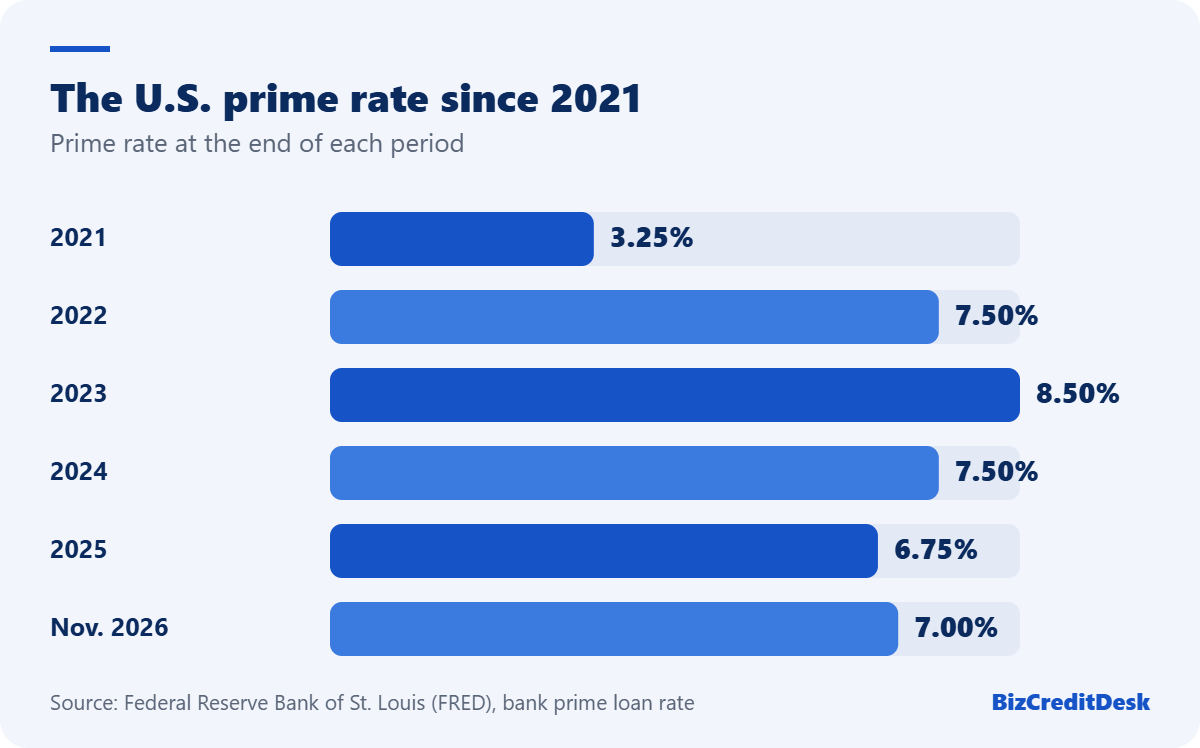
Banks are free to set their own prime rate, but in practice almost all of them follow the same rule: the upper bound of the Federal Reserve’s federal funds target range plus 3 percentage points. When the Fed raised its target range to 3.75%–4.00% in September 2026, prime moved from 6.75% to 7.00%. When the Fed held rates in October, prime stayed put. Read more in our guide on how Fed rate decisions affect your loans.
How prime affects what you pay
Suppose your credit card APR is prime + 15 percentage points. With prime at 7.00%, your APR is 22.00%. If the Fed raises rates by a quarter point and prime rises to 7.25%, your APR becomes 22.25%, usually within one or two billing cycles. The margin, 15 points in this example, is set by your card issuer based on your credit and generally stays the same.
- Credit cards: most have variable APRs linked to prime. Your agreement lists the margin.
- Home equity lines of credit (HELOCs): usually prime plus or minus a small margin, so payments can change quickly.
- Personal loans: most are fixed, but some variable-rate loans use prime as their index.
- Small business loans: SBA and bank lines of credit are often priced off prime.
How to protect yourself when prime rises
- Pay down variable-rate balances first; see our comparison of the debt avalanche and snowball methods.
- Consider moving revolving debt into a fixed-rate loan if it lowers your rate.
- Ask your card issuer for a lower margin if your credit has improved.
Key takeaways
- The U.S. prime rate is 7.00%, three points above the top of the Fed’s 3.75%–4.00% target range.
- It typically changes the day after the Fed changes rates.
- Variable-rate credit cards and HELOCs move with prime; fixed-rate loans don’t.
- Your rate is prime plus a margin that depends on your credit.