Last updated: November 21, 2026
Got a bonus, a tax refund or just some breathing room in your budget? Paying off a personal loan early can save you a real amount of interest. Before you send that big payment, though, check one thing: whether your loan has a prepayment penalty. Here’s how to find out, how much you could save and when paying early isn’t the best move.
The short version
| Paying off a personal loan early | |
|---|---|
| Can you do it? | Usually yes. Your contract and state law decide |
| Prepayment penalty | Many personal loans have none, but some lenders charge one |
| Where to check | Your loan agreement and Truth in Lending (TILA) disclosure |
| Main benefit | You stop paying interest on the balance you clear |
| Watch out for | Penalties, an origination fee you won’t get back, and leaving yourself without savings |
What is a prepayment penalty?
A prepayment penalty is a fee some lenders charge when you pay off all or part of a loan before the end of its term. Personal loans are paid in fixed monthly installments that include interest, so when you pay early, the lender collects less interest than it expected. The penalty makes up for part of that.
It’s usually set as a percentage of the remaining balance, a few months of interest, or a flat fee. Many online lenders and credit unions don’t charge one at all, which is why it’s worth comparing before you sign. See how to compare personal loan offers.
How to check if your loan has one
- Read your Truth in Lending disclosure. This is the summary of your loan’s cost that the lender must give you. It says whether you may have to pay a penalty if you pay off early.
- Search your loan agreement for words like “prepayment,” “early payoff” or “early termination.”
- Ask the lender for a payoff quote. It shows the exact amount needed to close the loan on a given date, including any fees.
The Consumer Financial Protection Bureau notes that your contract and your state’s law decide whether you can prepay without a fee, and that some states prohibit prepayment penalties on certain loans. If you’re still shopping, you can ask the lender to remove the clause or choose a loan without one.
How much can you save? An example
Say you borrowed $10,000 for 5 years at 12% APR, close to the Federal Reserve’s recent average for 24-month personal loans at commercial banks. Your payment is about $222 a month, and you’d pay about $3,347 in interest over the full term.
After two years of on-time payments, you’d still owe about $6,697. If you pay that off in one go:
- You’d have paid about $2,036 in interest instead of $3,347.
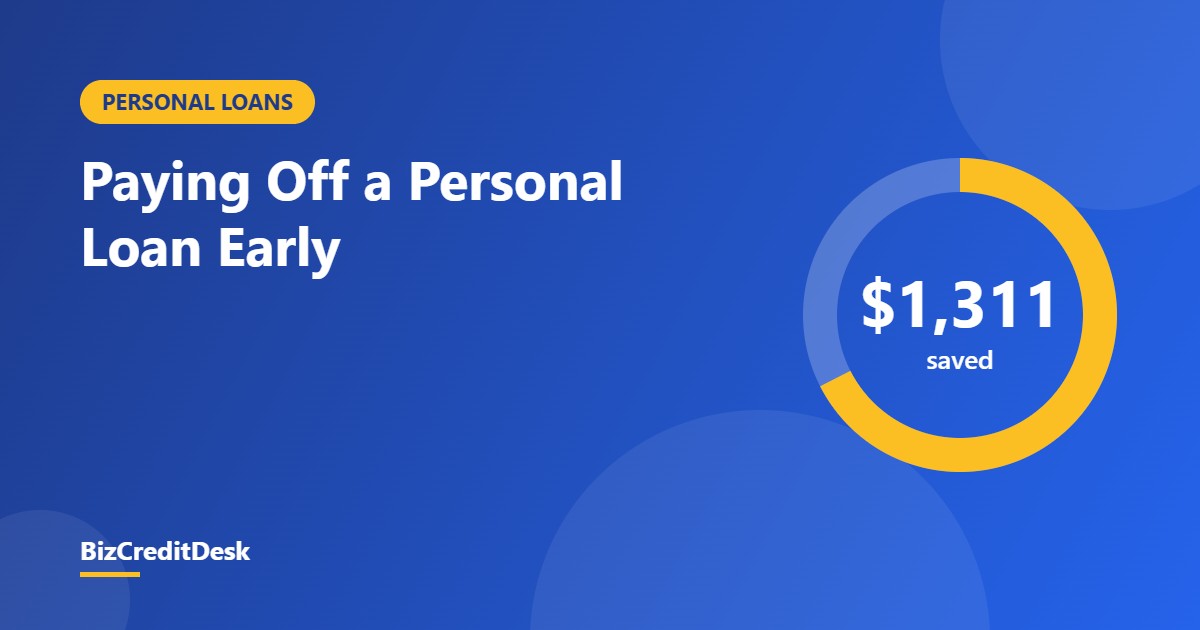
- That’s a saving of roughly $1,311.
- Even with a 2% penalty on the remaining balance (about $134), you’d still come out around $1,177 ahead.
The earlier in the term you pay, the more you save, because more of each early payment goes to interest. Any origination fee you paid upfront isn’t refunded, though, so leave it out of your savings math.
Paying extra instead of paying it all
You don’t have to clear the whole balance at once. Extra payments also shorten the loan and cut interest. Two tips:
- Tell the lender the extra amount should go to principal. Otherwise it may be treated as an early monthly payment instead of reducing your balance.
- Check that partial prepayments don’t trigger a fee too. Some contracts only charge for a full payoff, others for any extra payment above a limit.
Does paying off a loan early hurt your credit?
Your on-time payment history stays on your credit report, which keeps helping your score. When the loan closes, you have one fewer active installment account, so some people see a small, temporary dip, especially if it was their only loan. For most borrowers the lower debt matters more than that dip. Learn more in how credit scores are calculated.
When paying early isn’t the best move
- You have no emergency fund. If clearing the loan leaves you with no savings, an unexpected bill could push you onto a credit card at a much higher rate. Read emergency fund vs. paying off debt.
- You carry more expensive debt. Credit card balances usually cost more than a personal loan, so pay those first. See debt snowball vs. debt avalanche.
- The penalty eats the savings. Near the end of a loan, little interest is left, so a fee can cancel out the benefit.
Key takeaways
- Most personal loans can be paid off early, and many have no prepayment penalty.
- Check your Truth in Lending disclosure and loan agreement, or ask for a payoff quote.
- Paying early saves the most interest at the start of the term.
- Keep an emergency fund and clear higher-rate debt first.
Sources
This article is for educational purposes only and is not financial advice. See our Disclaimer.