
Last updated: November 1, 2026
You’ve been approved for a $10,000 personal loan, but only $9,400 lands in your bank account. Where did the other $600 go? Most likely, it was an origination fee. It’s one of the most common, and most overlooked, costs of a personal loan. Here’s how it works, how much it really adds to your loan and how to reduce or avoid it.
What is an origination fee?
An origination fee is a one-time charge a lender collects for processing and setting up your loan. The CFPB lists it among the fees personal installment loans may carry, alongside documentation fees, optional insurance and late fees (CFPB).
It’s usually a percentage of the loan amount. According to Experian, origination fees generally range from about 0.5% to 8% of the amount borrowed, and personal loans tend to sit toward the higher end (Experian). Your credit profile is often what determines where you land in that range.
How the fee is charged
Lenders collect it in one of three ways (Experian):
- Deducted from the loan: the most common approach for personal loans. You borrow $10,000, pay a 6% fee, and receive $9,400, but still repay the full $10,000 plus interest.
- Added to the balance: you get the full amount, and the fee is rolled into what you owe, so you also pay interest on it.
- Paid up front: less common for personal loans.
Tip: if you need a specific amount in hand, you’ll need to borrow more to cover a deducted fee. To net $10,000 with a 6% fee, you’d have to borrow about $10,638.
Why APR is the number to watch
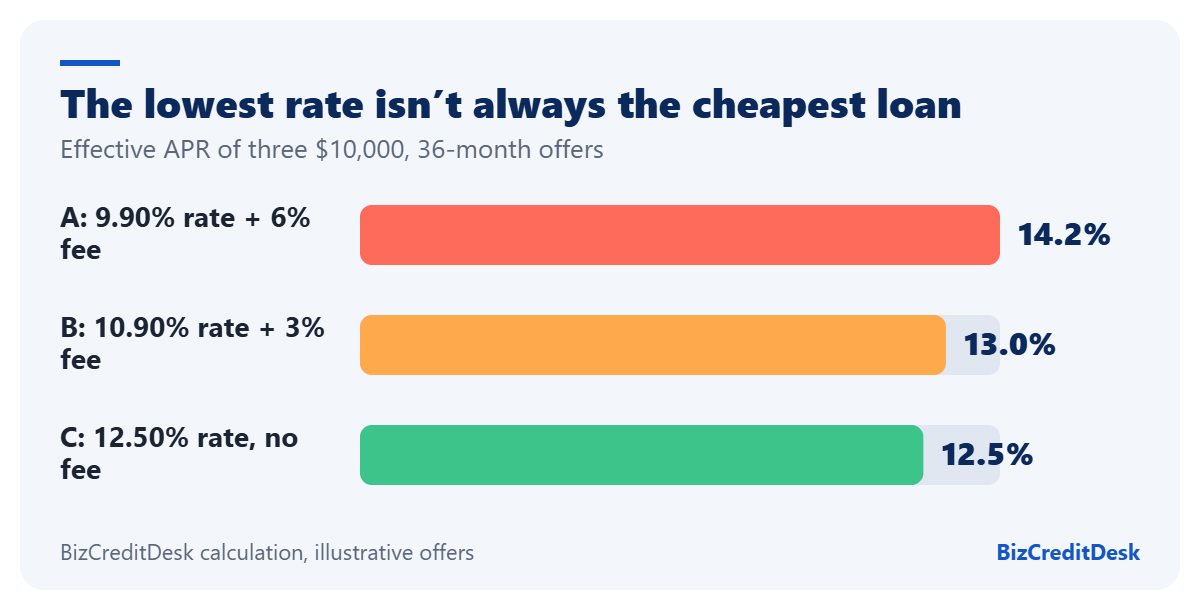
The interest rate alone doesn’t show the fee. The APR does, because it includes certain fees such as origination charges, which is why the CFPB recommends comparing APRs to APRs (CFPB). Here’s what that looks like for three $10,000, 36-month offers:
| Offer | Interest rate | Origination fee | Cash you receive | Monthly payment | Effective APR | Total cost |
|---|---|---|---|---|---|---|
| A | 9.90% | 6% ($600) | $9,400 | $322 | About 14.2% | $2,199 |
| B | 10.90% | 3% ($300) | $9,700 | $327 | About 13.0% | $2,069 |
| C | 12.50% | None | $10,000 | $335 | 12.5% | $2,043 |
Offer A has the lowest interest rate and the lowest payment, yet it’s the most expensive and gives you the least cash. Offer C, with the highest advertised rate, is actually the cheapest. “Total cost” here is everything you repay minus the cash you received.
When a fee can still make sense
An origination fee isn’t automatically bad. A loan with a fee can be the better deal if its lower interest rate saves more over the life of the loan than the fee costs, which is more likely with larger loans and longer terms, as long as you don’t pay the loan off early. The only way to know is to compare APRs and total cost for the same loan amount and term.
Also note that if you plan to pay a loan off early, an upfront fee becomes relatively more expensive, because you’ve paid it in full but use the money for less time.
How to avoid or reduce origination fees
- Look for no-fee lenders. Many banks, credit unions and online lenders don’t charge origination fees, though their rates may be a bit higher (Experian).
- Improve your credit first. Borrowers with stronger credit typically get lower fees. See what credit score you need for a personal loan.
- Ask to lower the fee. Experian notes many origination fees are negotiable, especially for borrowers with good credit.
- Check for duplicate charges. Make sure separate “processing” or “underwriting” fees aren’t being charged on top of the origination fee.
- Prequalify with several lenders and compare the APR and total cost, not just the rate. Our personal loan guide shows how.
Questions to ask every lender
- Do you charge an origination fee? How much?
- Is it deducted from the loan, added to the balance or paid up front?
- What is the APR, including the fee?
- Are there any other fees (late, returned payment, prepayment)?
- If I repay early, is any part of the fee refunded?
To understand how fees and rates interact, read how personal loan interest rates work.
Want to see how a fee changes which loan is actually cheapest? Our guide on how to compare personal loan offers walks through three examples.
Key takeaways
- An origination fee is a one-time charge, often deducted from the money you receive.
- Fees commonly range from about 0.5% to 8%, with personal loans toward the high end.
- A low rate with a high fee can cost more than a higher rate with no fee.
- Compare offers by APR and total cost for the same amount and term.
Sources
- Experian, What is an origination fee?
- CFPB, Do personal installment loans have fees?
- CFPB, What is the difference between a loan interest rate and the APR?
- Offer comparison: BizCreditDesk calculations, illustrative offers.
This article is for educational purposes only and is not financial advice. Fees and terms vary by lender. See our Disclaimer.