
Last updated: November 1, 2026
When you owe money on several accounts, the order you pay them off matters. The two most popular strategies are the debt snowball and the debt avalanche. Both work, and both are far better than paying only minimums. The difference is whether you’d rather save the most money or get quick wins that keep you motivated. Here’s how each method works, with real numbers.
The two methods in one sentence each
- Debt avalanche: pay minimums on everything, then put every extra dollar toward the debt with the highest interest rate.
- Debt snowball: pay minimums on everything, then put every extra dollar toward the smallest balance.
In both cases, when one debt is paid off, you roll its payment into the next one, so your payments grow over time. The CFPB describes both approaches and suggests choosing the one that best fits what motivates you (CFPB).
A real example
Imagine you have three debts and can put $550 a month toward them in total:
| Debt | Balance | APR | Minimum payment |
|---|---|---|---|
| Small personal loan | $1,500 | 9.9% | $60 |
| Card A | $4,000 | 21.9% | $100 |
| Card B | $6,000 | 27.9% | $150 |
That’s $11,500 in total debt. Here’s how the two strategies compare:
| Debt avalanche | Debt snowball | |
|---|---|---|
| Payoff order | Card B → Card A → Loan | Loan → Card A → Card B |
| First debt paid off | Month 20 | Month 6 |
| Debt-free in | 27 months | 29 months |
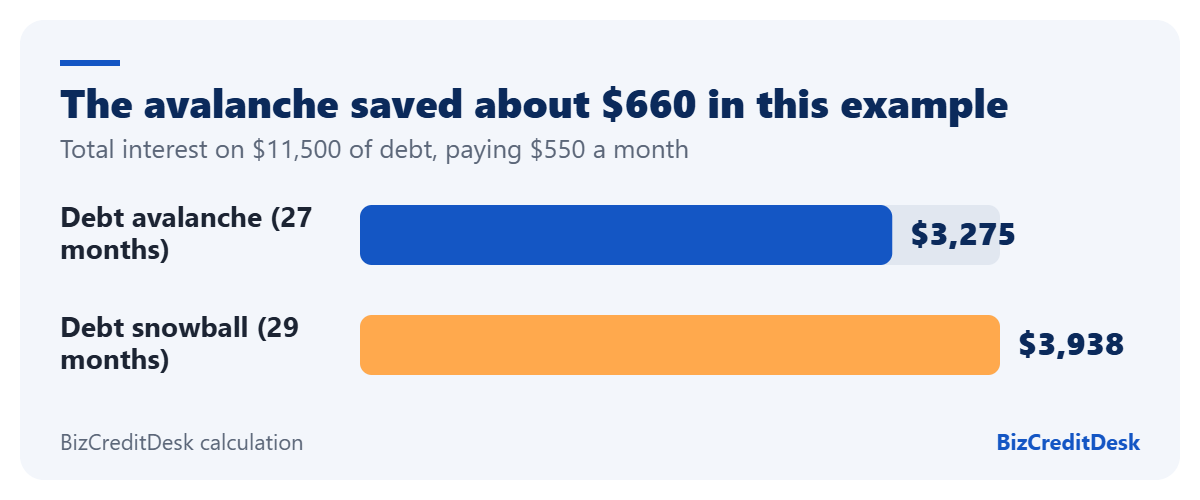
| Total interest paid | About $3,275 | About $3,938 |
In this example, the avalanche saves about $660 and finishes two months sooner. But the snowball delivers the first win in month 6 instead of month 20, which can make a real difference to staying on track.
Debt avalanche: pros and cons
- Pros: mathematically the cheapest way to pay off debt; often the fastest overall.
- Cons: if your highest-rate debt is also large, it may be many months before you pay anything off completely, which can be discouraging.
- Best for: people motivated by numbers who can stay disciplined without quick wins.
Debt snowball: pros and cons
- Pros: fast early victories; fewer bills to track sooner; builds momentum.
- Cons: usually costs more in interest because high-rate balances keep growing longer.
- Best for: people who’ve struggled to stick with a plan and need visible progress.
Which one should you choose?
If your smallest debts also happen to have the highest rates, the two methods produce the same order and you don’t have to choose. When they differ:
- Choose the avalanche if the interest savings are large and you’re confident you’ll stick with it.
- Choose the snowball if you’ve tried before and lost motivation.
- Or use a hybrid: knock out one or two tiny balances for quick wins, then switch to the avalanche.
The best method is the one you’ll actually follow until the end.
How to get started
- List every debt with its balance, APR and minimum payment.
- Set your monthly debt budget: the total you can commit beyond your essential expenses.
- Set up autopay for every minimum so you never miss a payment.
- Send all extra money to your target debt each month.
- Roll payments forward as each debt is paid off.
- Stop adding new debt to the cards you’re paying down.
Can you combine this with consolidation?
Yes. If you qualify for a much lower rate, a debt consolidation loan or a balance transfer card can reduce the interest you pay, and you can still apply the snowball or avalanche to any remaining debts. Paying down card balances also lowers your credit utilization, which can improve your score; see how credit scores are calculated.
Key takeaways
- The avalanche targets the highest rate first and minimizes interest.
- The snowball targets the smallest balance first and maximizes early motivation.
- Both beat paying only minimums by a wide margin.
- Pick the method you’ll stick with, and keep rolling payments forward.
Sources
- CFPB, How to reduce your debt
- Payoff figures: BizCreditDesk calculations based on the example above, assuming fixed APRs and no new charges.
This article is for educational purposes only and is not financial advice. See our Disclaimer.