
Last updated: November 5, 2026
APR and APY look almost identical, and both describe interest as a yearly percentage. But they’re used for opposite sides of your finances: APR is usually what you pay when you borrow, while APY is what you earn when you save. Mixing them up can make a loan look cheaper or a savings account look better than it really is.
The short version
| APR (annual percentage rate) | APY (annual percentage yield) | |
|---|---|---|
| Used for | Loans and credit cards | Savings accounts, CDs, money market accounts |
| Includes compounding? | No | Yes |
| Includes fees? | On loans, includes certain fees | No |
| Required disclosure | Truth in Lending Act | Truth in Savings Act |
| You want it to be… | Low | High |
What is APR?
APR is the yearly cost of borrowing. On a loan, it includes the interest rate plus certain lender fees, such as origination fees, which is why the CFPB says to compare APRs to APRs rather than to interest rates (CFPB). Lenders must disclose it under the Truth in Lending Act.
APR doesn’t reflect compounding, though. That matters most for credit cards, where interest is typically calculated daily or monthly on your balance.
What is APY?
APY shows how much you’ll earn on a deposit in a year, including compound interest, meaning interest earned on the interest you’ve already earned. Banks and credit unions must calculate and disclose APY using a standard formula set by federal regulation, so you can compare accounts fairly (CFPB, Regulation DD).
How compounding makes the difference
The more often interest compounds, the bigger the gap between the stated rate and the effective yearly rate:
| Stated rate | Compounded | Effective yearly rate |
|---|---|---|
| 4.00% (savings) | Monthly | About 4.07% APY |
| 4.00% (savings) | Daily | About 4.08% APY |
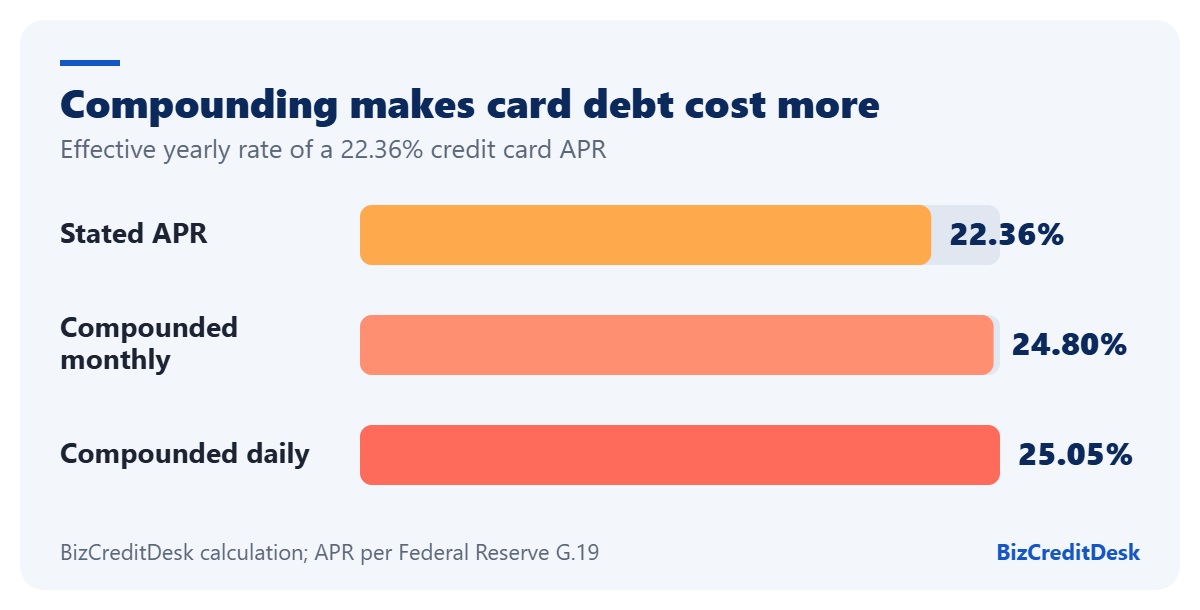
| 22.36% APR (credit card) | Monthly | About 24.80% effective |
| 22.36% APR (credit card) | Daily | About 25.05% effective |
The 22.36% figure is the August 2026 average for credit card accounts charged interest (Federal Reserve G.19). If you carry a balance month to month, your true yearly cost is higher than the APR on your statement.
The formula: APY = (1 + rate ÷ n)n − 1, where n is the number of compounding periods per year.
Why the difference matters
- Comparing loans: use APR, since it captures fees. Check our guide to how personal loan interest rates work.
- Comparing savings accounts: use APY, which makes accounts with different compounding schedules directly comparable.
- Watch the marketing: a lender may advertise a low “rate,” and a bank may highlight a high APY. Make sure you’re comparing the same measure.
Putting it to work
- Pay off high-APR debt first. A card charging over 22% costs far more than most savings accounts can earn.
- Keep your emergency fund in a high-APY, insured account. Deposits at FDIC-insured banks are protected up to $250,000 per depositor, per bank, per ownership category (FDIC).
- Compare the real return: an APY below the inflation rate means your savings are losing purchasing power. See how inflation affects your money.
Key takeaways
- APR is for borrowing; APY is for saving.
- APY includes compounding; APR does not.
- Compare loans by APR and savings accounts by APY.
- Credit card interest compounds, so carrying a balance costs more than the APR suggests.
Sources
This article is for educational purposes only and is not financial advice. See our Disclaimer.