
Last updated: November 1, 2026
Bad credit doesn’t automatically shut you out of borrowing, but it does change the rules. You’ll see fewer offers, higher rates and more lenders who want to take advantage of people in a tight spot. The goal is to find the least expensive option that solves your problem without making your finances worse. This guide walks through your realistic options, from best to worst, and the traps to avoid.
First, know where you stand
On the FICO scale, scores from 580 to 669 are considered “fair,” and below 580 is “poor” (Experian). Before applying anywhere:
- Pull your credit reports from all three bureaus at AnnualCreditReport.com, where free reports are now available weekly (FTC).
- Look for errors. A mistaken late payment or an account that isn’t yours could be dragging your score down. See our guide on how to read your credit report and dispute errors.
- Know your budget. Decide the maximum monthly payment you can truly afford before you look at offers.
Your best options with bad credit
1. Credit union loans, including PALs
Credit unions are nonprofits and are often more flexible with members who have imperfect credit. Federal credit unions can offer payday alternative loans (PALs) of up to $2,000, with interest capped at 28% (America’s Credit Unions). Some PALs require you to have been a member for at least a month.
2. Secured personal loans
If you have savings or a certificate of deposit, a share-secured or CD-secured loan lets you borrow against it. Because the lender’s risk is low, approval is easier and rates are usually lower. On-time payments also help rebuild your credit.
3. A cosigner or co-borrower
A family member or friend with good credit can cosign, which may get you approved at a much better rate. Be clear about the stakes: if you miss payments, they are legally responsible and their credit takes the hit too.
4. Online lenders that work with fair credit
Some online lenders specialize in borrowers with fair or poor credit. They can be a legitimate option, but rates can approach or exceed 36% APR and origination fees are common. Always compare by APR and prequalify with soft credit checks first.
5. Alternatives to borrowing
- Ask your creditors for a payment plan, a due date change or a temporary hardship program.
- Talk to a nonprofit credit counselor through the National Foundation for Credit Counseling.
- Check for local assistance with utilities, rent or medical bills before taking on debt.
What it really costs: $1,000 compared
| Option | Terms | Approximate cost |
|---|---|---|
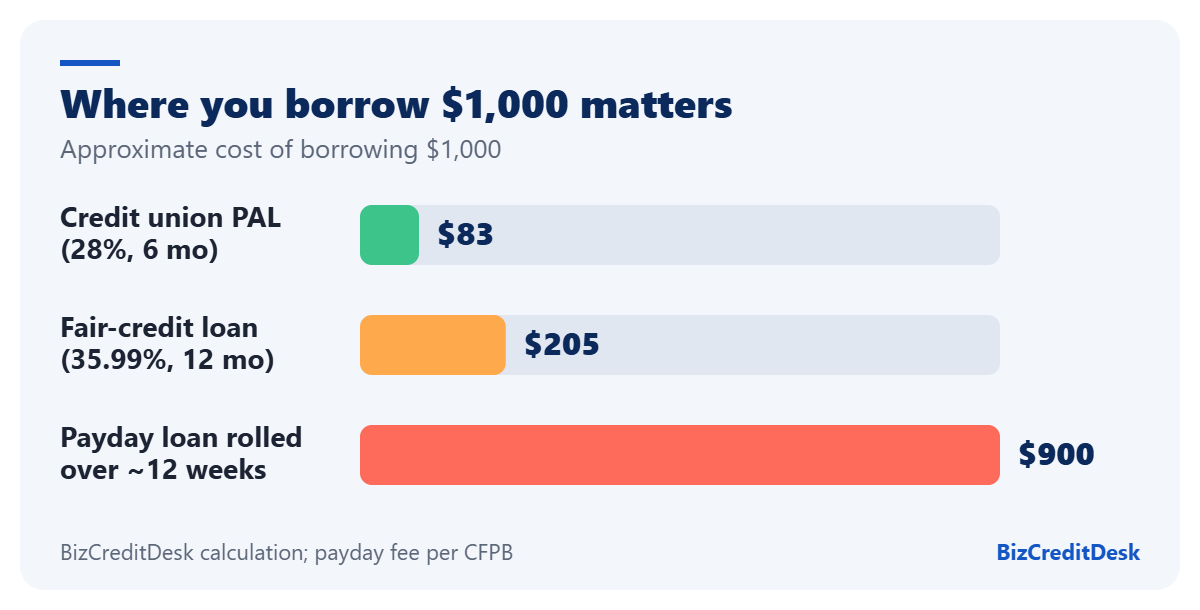
| Credit union PAL | 28% APR, 6 months | About $83 in interest |
| Fair-credit personal loan | 35.99% APR, 12 months | About $205 in interest |
| Payday loan, rolled over for about 12 weeks | $15 fee per $100 every two weeks | About $900 in fees, and you still owe the $1,000 |
The payday figure isn’t a typo. The CFPB notes that a typical fee of $15 per $100 borrowed equals an APR of almost 400% on a two-week loan (CFPB), and the cost explodes when the loan is renewed again and again.
Options to avoid or use only as a last resort
- Payday loans: very short terms and extremely high costs make it easy to get stuck re-borrowing.
- Car title loans: you hand over your car title as collateral and risk losing your vehicle if you can’t repay.
- “Guaranteed approval, no credit check” offers: the FTC warns that guaranteed approval and upfront fees are classic signs of loan scams (FTC). A legitimate lender won’t ask you to pay before you get the money.
How to improve your chances of approval
- Borrow less. Smaller loans are easier to approve.
- Lower your debt-to-income ratio by paying down a balance first, if you can.
- Show stable income with pay stubs or bank statements.
- Apply where you already bank; your history with them can help.
- Prequalify with several lenders, then submit one formal application.
Adding someone with stronger credit to your application can also help. Before you ask, read co-signer vs. co-borrower on a personal loan so you both know what each role means.
Use the loan to rebuild your credit
A loan you repay on time can actually improve your score, because payment history is the biggest part of a FICO score (myFICO). Set up autopay, never miss a due date and avoid adding new debt. In a year, you may qualify for much better offers. Learn more in how credit scores are calculated.
Key takeaways
- Start with credit unions, secured loans or a cosigner before high-cost lenders.
- Compare every offer by APR and total cost, including fees.
- Avoid payday and title loans; their real cost can be enormous.
- Never pay an upfront fee to “guarantee” a loan.
- Repaying on time is one of the best ways to rebuild your credit.
Sources
- CFPB, What are the costs and fees for a payday loan?
- America’s Credit Unions, Comparing PALs I and PALs II loans
- FTC, What to know about advance-fee loans
- Experian, What is the average credit score in the U.S.?
- myFICO, What’s in my FICO Scores?
- Cost comparison: BizCreditDesk calculations based on the terms shown.
This article is for educational purposes only and is not financial advice. Loan terms, fees and state rules vary. See our Disclaimer.