
Last updated: November 1, 2026
Debt consolidation and debt settlement sound similar, and ads for both often appear side by side. But they work in completely different ways and carry very different risks. With consolidation, you repay everything you owe, ideally at a lower rate. With settlement, a company tries to get your creditors to accept less than you owe, usually after you’ve stopped paying them. Here’s how to tell them apart and decide which, if either, fits your situation.
At a glance
| Debt consolidation | Debt settlement | |
|---|---|---|
| What it does | Combines debts into one new loan or card | Negotiates to pay creditors less than the full balance |
| Do you repay everything? | Yes | No, if settlements succeed |
| Do you keep paying creditors? | Yes, through the new loan | Programs often tell you to stop |
| Credit impact | Small temporary dip, often improves over time | Usually significant damage |
| Main costs | Interest, possible origination fee | Settlement fees, late fees and penalties, possible taxes |
| Main risks | Running up the old cards again | Lawsuits, unsettled debts, losing fees paid |
| Who it’s for | People who can afford the payments and qualify for a lower rate | People in serious hardship who can’t repay in full |
How debt consolidation works
You take out a personal loan or a balance transfer card, pay off your existing debts and then make one payment on the new account. The goal is a lower interest rate and a clear payoff date. Your accounts stay in good standing, and on-time payments can help your score. Learn more in our guide to what debt consolidation is and how it affects your credit.
How debt settlement works
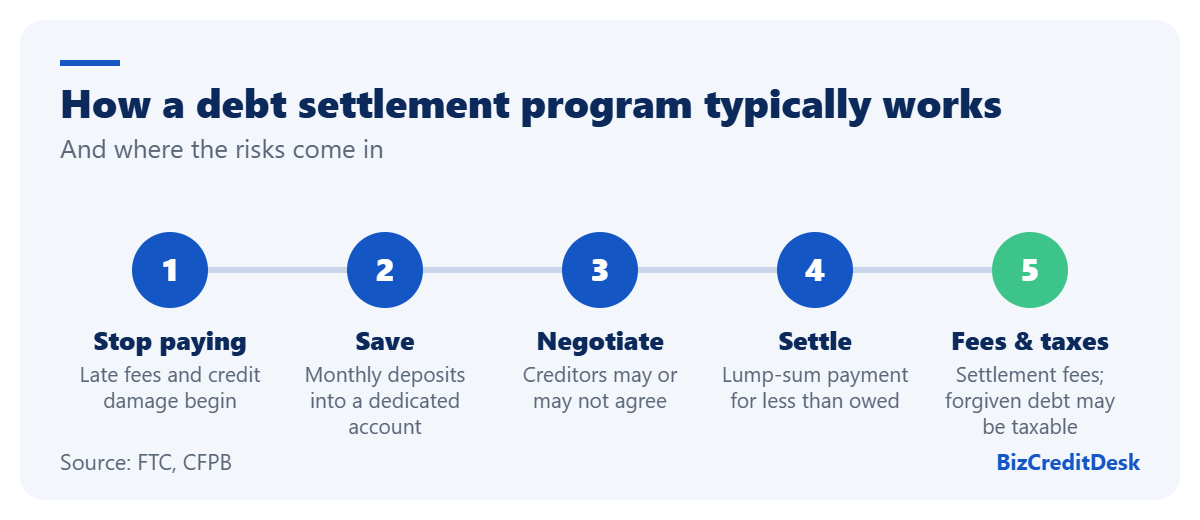
A debt settlement (or “debt relief”) company typically asks you to stop paying your creditors and instead deposit money each month into a dedicated savings account. Once enough builds up, the company tries to negotiate a lump-sum settlement for less than the balance.
The FTC explains that a debt settlement company can’t collect its fees before it settles your debt, and that you’re entitled to the money in the dedicated account and can withdraw it without penalty (FTC).
The risks are serious
The CFPB warns that debt settlement may leave you deeper in debt than when you started (CFPB). The main reasons:
- Your credit takes a big hit. Stopping payments leads to late payments and possibly charge-offs, which can stay on your report for up to seven years.
- Balances can grow. Late fees and penalty interest keep piling up while you save.
- Creditors don’t have to settle. Some refuse to work with settlement companies.
- You can be sued. The FTC notes creditors may take you to court and, if they win, could garnish wages or place a lien on your home (FTC).
- Forgiven debt may be taxable. Both the CFPB and FTC note that the amount forgiven may count as income. Lenders generally must file IRS Form 1099-C when they cancel $600 or more of debt (IRS).
- Many people don’t finish. If you drop out, you may have paid fees and still owe the unsettled debts.
A simple example
Suppose you owe $20,000 on credit cards.
- Consolidation: a 48-month loan at 11.90%, the August 2026 bank average for personal loans (Federal Reserve G.19), means a payment of about $526 and about $5,233 in interest. You repay everything, and your credit stays intact if you pay on time.
- Settlement (illustrative): if creditors agreed to accept half and the company charged a fee equal to 20% of the enrolled debt, you’d pay about $14,000. But you could also owe taxes on the $10,000 forgiven, face late fees and lawsuits along the way, and see serious credit damage. And there’s no guarantee every creditor settles.
Settlement can look cheaper on paper, but it trades money for risk and credit damage. It’s generally a last resort for people who truly can’t repay, not a shortcut for people who can.
Red flags of a debt relief scam
The CFPB lists warning signs, including companies that (CFPB):
- Charge fees before settling any of your debts
- Promise a specific percentage reduction or guarantee your debt will disappear
- Tell you to stop talking to your creditors
- Promise to stop all collection calls and lawsuits
- Advertise a “new government program” to wipe out credit card debt
A middle option: debt management plans
A nonprofit credit counselor can set up a debt management plan (DMP). You make one monthly deposit to the counseling agency, which pays your creditors, often at reduced interest rates. Unlike settlement, you repay the full balance. The FTC notes plans typically take 48 months or more and cover unsecured debts like credit cards and medical bills (FTC). You can find a counselor through the National Foundation for Credit Counseling.
Which should you choose?
- Choose consolidation if you can afford the payments and qualify for a lower rate.
- Consider a debt management plan if you can repay in full but need lower rates and structure.
- Consider settlement only if you’re facing real hardship, can’t repay in full and have explored the other options, ideally after talking to a nonprofit counselor or a bankruptcy attorney.
Not sure where to start? Try ordering your debts with the snowball or avalanche method first.
Key takeaways
- Consolidation repays everything at a lower rate; settlement pays less than you owe.
- Settlement usually damages your credit and can lead to lawsuits and taxes.
- Legitimate settlement companies can’t charge fees before settling a debt.
- A nonprofit debt management plan is a safer middle ground for many people.
Sources
This article is for educational purposes only and is not financial, legal or tax advice. See our Disclaimer.