
Last updated: November 3, 2026
Need to pay for something big, like a car repair, a medical bill or a home project? The two most common ways to borrow are a personal loan and a credit card. Which one is cheaper depends on how much you need, how fast you can pay it back and what offers you qualify for. Here’s how to decide.
The key differences
| Personal loan | Credit card | |
|---|---|---|
| How you get money | Lump sum up front | Revolving line you draw from as needed |
| Average rate (Aug. 2026) | 11.90% (24-month, commercial banks) | 22.36% (accounts charged interest) |
| Rate type | Usually fixed | Usually variable |
| Payment | Fixed monthly installment | Minimum payment that changes with the balance |
| Payoff date | Set by the loan term | None unless you set one |
| Fees | Possible origination fee | Possible annual, late or balance transfer fees |
| Interest-free option | Rarely | Grace period if you pay in full; 0% intro offers |
Rates: Federal Reserve G.19.
A real example: $6,000 expense
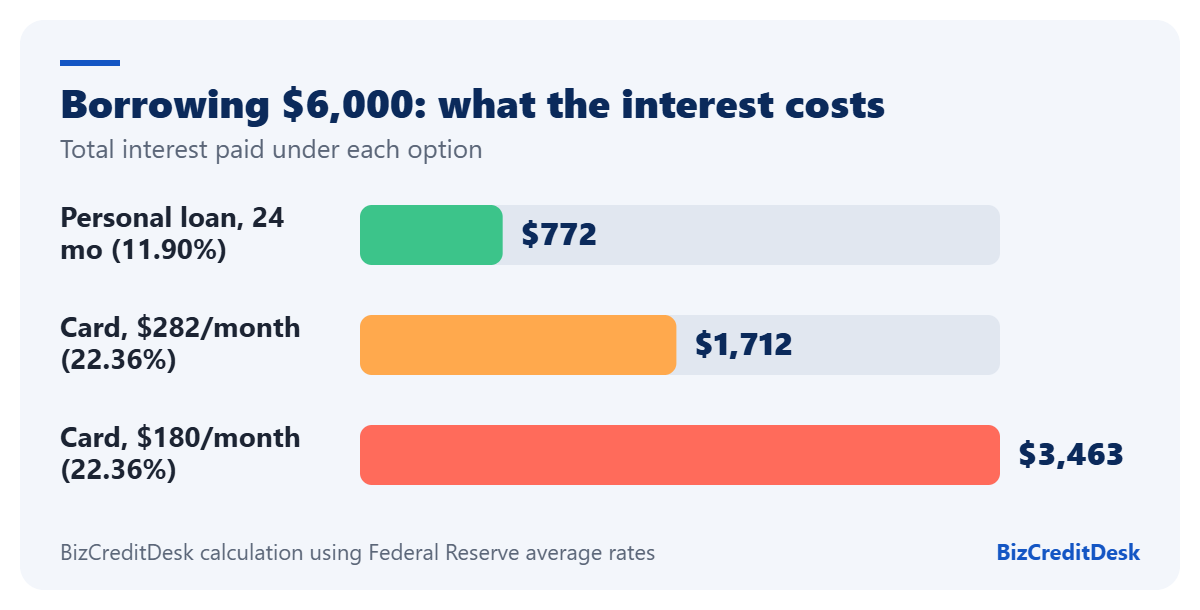
Suppose you need $6,000 and can pay about $282 a month.
| Option | Time to pay off | Total interest |
|---|---|---|
| 24-month personal loan at 11.90% | 24 months | About $772 |
| Credit card at 22.36%, paying $282/month | 28 months | About $1,712 |
| Credit card at 22.36%, paying only $180/month | 53 months | About $3,463 |
With the same monthly payment, the loan costs less than half as much in interest. And the danger with a card is that nothing forces you to pay it off: paying less each month stretches the debt over years.
When a personal loan is the better choice
- Larger expenses you’ll need more than a year to repay.
- You want a fixed payment and a firm end date.
- You’re consolidating card debt into a lower rate. See what debt consolidation is.
- Your credit qualifies you for a rate well below your card’s APR.
When a credit card is the better choice
- Small purchases you can pay off within the grace period. If you pay the full statement balance by the due date, you typically pay no interest on purchases.
- A 0% introductory APR offer. If you qualify for, say, 15 months at 0% and can pay about $400 a month, you could clear $6,000 interest-free, plus any fee. Make sure you finish before the promotion ends.
- Ongoing or uncertain costs, where you don’t know the exact amount yet.
- Purchase protections or rewards that matter for the specific purchase.
Watch out for these traps
- Minimum payments on cards. They keep you in debt far longer and cost much more.
- Origination fees on loans. A low rate with a high fee can cost more than a higher rate with none. Read what an origination fee is.
- Borrowing more than you need because the lender approved a larger amount.
- Running up cards after paying them off with a loan.
How each affects your credit
Both involve a hard inquiry when you apply. A large card balance raises your credit utilization, which can lower your score, while an installment loan balance generally isn’t counted in utilization the same way. On-time payments on either one help build your payment history.
Quick decision guide
- Can you pay it off within a month? Use a card and pay in full.
- Do you qualify for a long 0% intro offer and can finish within it? A card may be cheapest.
- Will it take more than a year, or do you need structure? A personal loan is usually better.
Ready to compare loan offers? Start with our step-by-step personal loan guide.
Key takeaways
- Personal loans averaged about half the rate of credit cards in August 2026.
- Loans offer fixed payments and an end date; cards offer flexibility.
- Cards win for short-term borrowing paid in full or within a 0% promotion.
- For larger amounts paid over time, a personal loan is usually cheaper.
Sources
- Federal Reserve, Consumer Credit G.19 (released October 7, 2026)
- Payment examples: BizCreditDesk calculations.
This article is for educational purposes only and is not financial advice. See our Disclaimer.