

Last updated: November 8, 2026
A single missed payment or an account sent to collections can follow you for years, but not forever. Federal law puts a time limit on how long most negative information can appear on your credit report. Knowing those limits helps you plan, spot reporting errors and avoid paying companies that promise to “erase” accurate information.
The short version
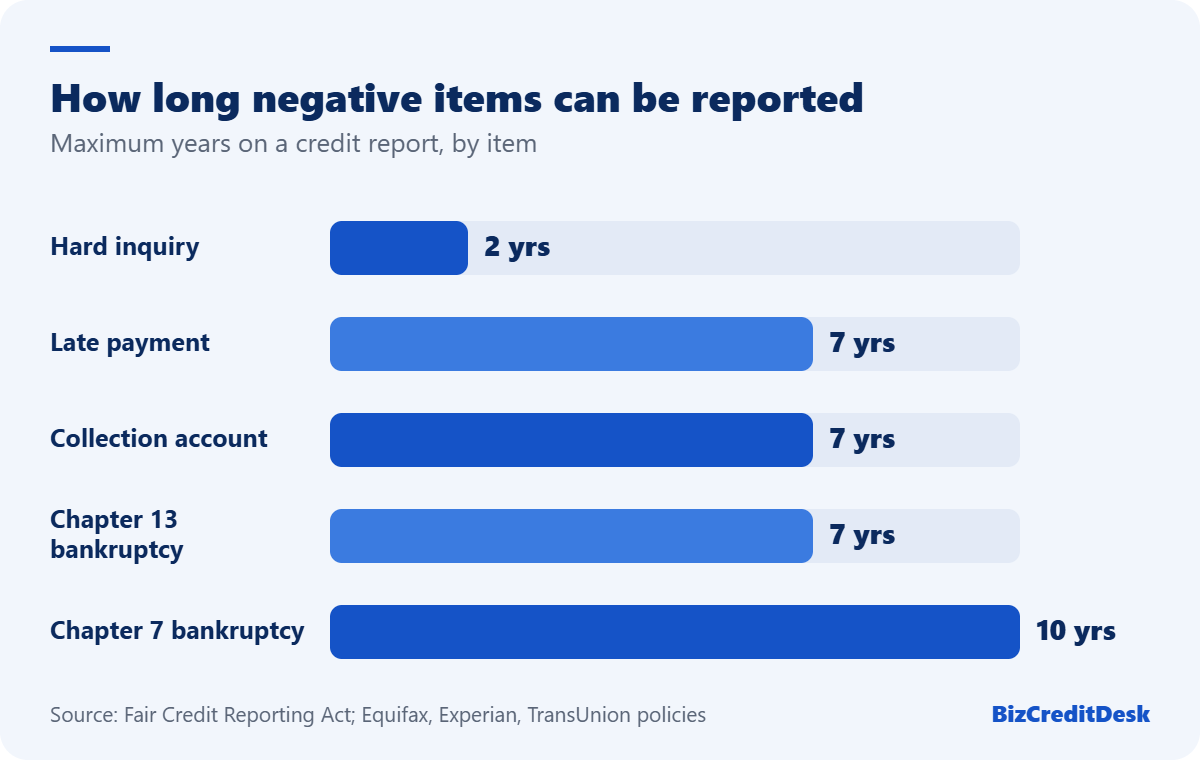
| Item | How long it can stay | Clock starts |
|---|---|---|
| Late payment (30+ days) | 7 years | Date of the missed payment |
| Collection account | 7 years | Original delinquency on the debt (plus up to 180 days) |
| Charge-off | 7 years | Original delinquency |
| Chapter 13 bankruptcy | 7 years | Filing date (credit bureau policy) |
| Chapter 7 bankruptcy | 10 years | Filing date |
| Hard inquiry | 2 years | Date of the inquiry |
Where the seven-year rule comes from
The Fair Credit Reporting Act (FCRA) generally bars credit bureaus from reporting most negative information that is more than seven years old. Bankruptcies are the main exception: the law allows them for up to ten years. In practice, the three national bureaus, Equifax, Experian and TransUnion, remove completed Chapter 13 bankruptcies after seven years and Chapter 7 bankruptcies after ten.
Positive information has no such limit. An account you paid on time can stay on your report for as long as it is open and, at the major bureaus, for about ten years after you close it.
When does the clock start?
The seven-year period is tied to the original delinquency, not to the most recent activity on the account. That matters in two common situations:
- Debts sold to collectors. If a debt is sold to a new collection agency, the clock does not restart. The collection account must come off on the same schedule as the original delinquency.
- Paying an old debt. Paying a collection account changes its status to “paid,” which some newer scoring models ignore entirely, but it does not reset the reporting period.
Do not confuse the credit reporting period with the statute of limitations for collecting a debt. The statute of limitations is set by state law, varies by debt type and determines whether you can be sued, not how long the debt appears on your report.
Medical debt and other special cases
Since 2023 the three bureaus have voluntarily removed paid medical collections and medical collections under $500 from credit reports, and they wait a year before reporting new unpaid medical collections. Civil judgments and tax liens no longer appear on credit reports at all. Rules in this area have changed several times recently, so check your own report rather than assuming.
Does the damage fade before seven years?
Yes. Scoring models weigh recent behavior more heavily than old problems. A late payment from five years ago hurts far less than one from last month, especially if everything since then has been paid on time. Payment history is the biggest factor in a FICO score, as we explain in how credit scores are calculated, so a long run of on-time payments is the most reliable way to recover.
What you can do now
- Check your reports. You can get free reports from all three bureaus at AnnualCreditReport.com.
- Dispute items past their limit or simply wrong. Our guide on how to read your credit report and dispute errors walks through the process.
- Ask for a goodwill adjustment. If a single late payment was a one-off, some lenders will agree to remove it if you ask politely and your record is otherwise clean. They are not required to.
- Avoid credit repair scams. No company can legally remove accurate, timely information. Anything you could do through a paid service you can do yourself for free.
Key takeaways
- Most negative items can be reported for seven years; Chapter 7 bankruptcy for ten; hard inquiries for two.
- The clock starts with the original delinquency and does not restart when a debt is sold or paid.
- Older items matter less to your score, so steady on-time payments speed up recovery.
- Accurate information cannot be removed early, but errors can and should be disputed.