

Last updated: November 8, 2026
Lenders want to see a track record before they lend, but you can’t build a track record without someone lending to you. The good news: several products are designed for people with no credit history, and most people can generate their first credit score within about six months of opening an account.
The short version
| Option | What you need | Best for |
|---|---|---|
| Secured credit card | A refundable deposit, often $200–$500 | Most people starting out |
| Credit-builder loan | Small monthly payments | People who want forced savings |
| Authorized user | A family member with good credit | Young adults |
| Student or starter card | Income; sometimes enrollment | Students with some income |
| Rent and bill reporting | On-time rent or utility history | Adding data to a thin file |
| Co-signed loan | A co-signer willing to share the risk | Larger needs, used with caution |
Why you have no score yet
A credit score is calculated from the information in your credit report. If no lender has ever reported an account in your name, there is nothing to score. Under FICO’s minimum criteria you generally need at least one account that has been open for six months and at least one account reported to a bureau within the past six months.
1. Open a secured credit card
A secured card works like a regular credit card, except you put down a cash deposit that usually becomes your credit limit. Because the deposit protects the issuer, approval is easier. Before applying, confirm that the card reports to all three bureaus and check whether it can “graduate” to an unsecured card and return your deposit after a period of on-time payments.
2. Take out a credit-builder loan
Offered mainly by credit unions and community banks, a credit-builder loan holds the amount you borrow in a locked savings account while you make monthly payments. When you finish, you get the money. Each on-time payment is reported, so you build history and savings at the same time. Interest and fees are usually small, but compare them before you sign.
3. Become an authorized user
If a parent or partner adds you to a credit card they have managed well, that account’s history can appear on your report. You don’t even need to use the card. The risk runs both ways: if the primary cardholder misses payments or runs up a high balance, your credit can suffer too.
4. Apply for a student or starter card
Some issuers offer unsecured cards with low limits for people with limited history. You must show that you can repay from your own income or assets. Approval is not guaranteed, so a secured card is often the safer first step.
5. Get credit for rent and bills
Rent reporting services and tools like Experian Boost can add rent, utility, phone and streaming payments to your file. Results vary because not every scoring model or lender uses this data, but it can help a thin file.
6. Use a co-signer, carefully
A co-signer with strong credit can help you get approved for a loan. They are fully responsible if you don’t pay, and late payments hurt both of you. Only consider this for a necessary loan you are confident you can repay.
Habits that turn history into a good score
- Pay on time, every time. Set up autopay for at least the minimum payment.
- Keep balances low. Using a small share of your limit helps; see our explanation of the 30% credit utilization rule.
- Space out applications. Each application usually triggers a hard inquiry.
- Keep your first account open. It anchors the age of your credit history.
Key takeaways
- You need an account reported for roughly six months before a FICO score can be generated.
- Secured cards and credit-builder loans are the most reliable starting points.
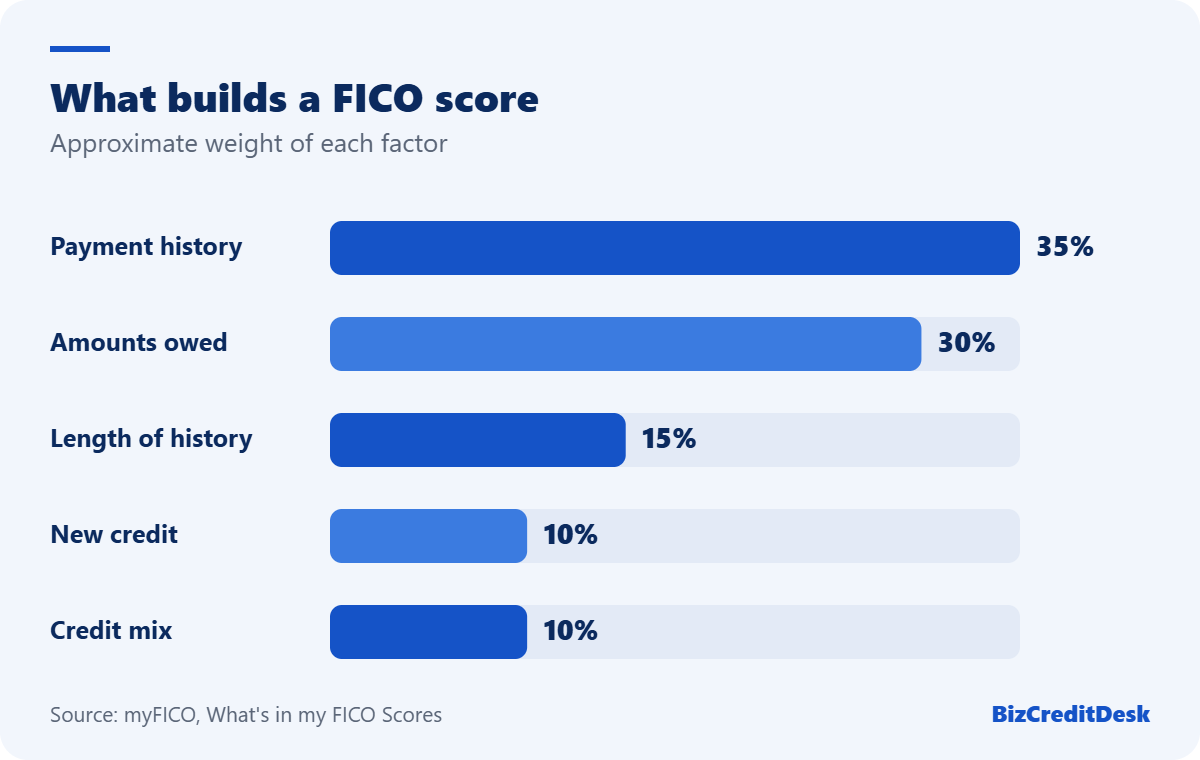
- Payment history and amounts owed make up about two-thirds of a FICO score.
- Check that any product reports to all three credit bureaus before you sign up.