

Last updated: November 8, 2026
Missing a loan payment happens more often than people admit: a paycheck arrives late, autopay fails or an emergency drains your account. One missed payment won’t ruin your finances if you act quickly. The consequences grow the longer the payment stays unpaid, so it helps to know the timeline.
The short version
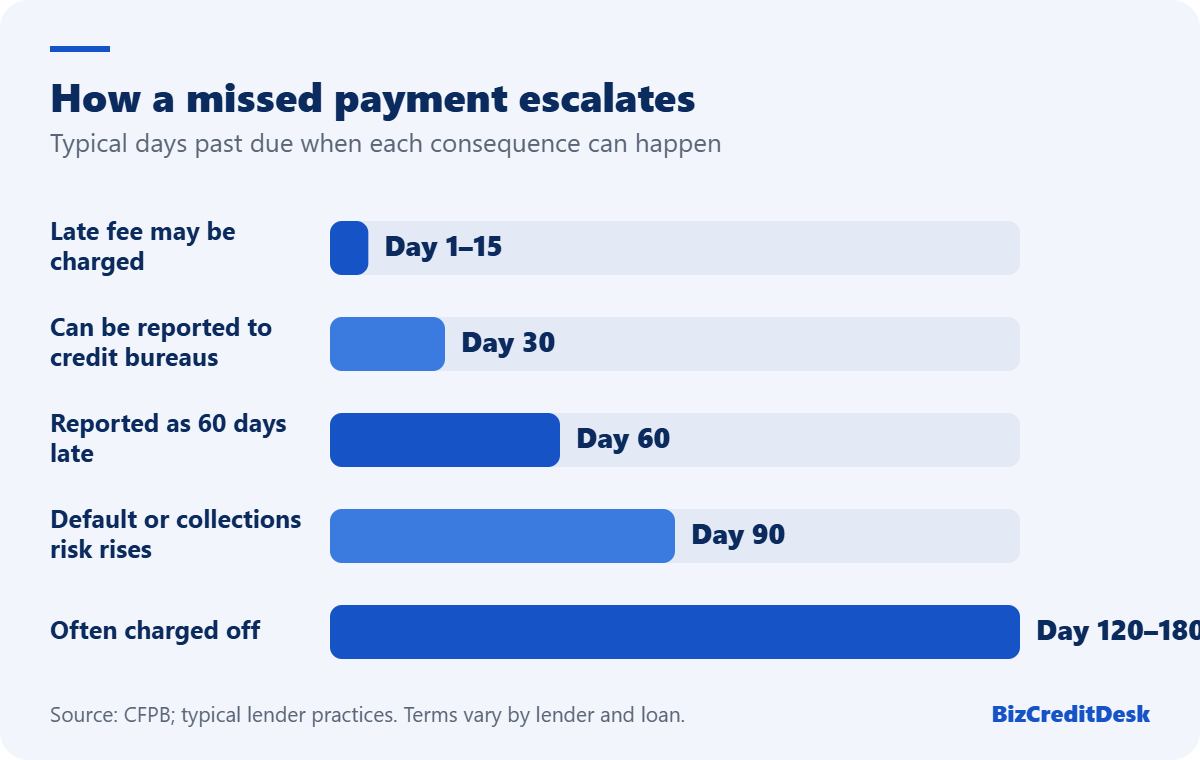
| Days late | What usually happens |
|---|---|
| 1–15 | Late fee may apply after any grace period; no credit report impact yet |
| 30 | Lender can report the late payment to the credit bureaus |
| 60–90 | More late marks, more fees, possible penalty interest; collection calls |
| 90–180 | Loan may go into default, be charged off and sent or sold to collections |
| After default | Possible lawsuit and wage garnishment; collateral can be repossessed on secured loans |
The first few days: fees, not credit damage
Many loans include a grace period, often 10 to 15 days, before a late fee applies. Check your loan agreement for the exact terms. A payment that is a few days late will cost you a fee but typically won’t appear on your credit report, because lenders generally don’t report a payment as late until it is at least 30 days past due.
30 days late: the credit report hit
Once a payment is 30 days overdue, the lender can report it to Equifax, Experian and TransUnion. Payment history is the most important factor in your score, so a first late payment can cause a significant drop, especially if your credit was previously strong. That mark can remain for seven years, as we explain in how long negative items stay on your credit report.
60 to 180 days: default and collections
Each additional month adds another, more serious late mark. Somewhere between 90 and 180 days, depending on the lender, the loan may be considered in default. The lender may “charge off” the debt as a loss and hand it to a collection agency or sell it. You still owe the money, and a collection account adds another negative item to your report.
For secured loans, the lender may also repossess the collateral. Federal student loans follow different rules, with default typically occurring after 270 days.
What to do if you’ve missed a payment
- Pay as soon as you can. If you pay before the 30-day mark, you will most likely avoid any credit report damage.
- Call your lender. Explain what happened. Many lenders will waive a first late fee or offer a hardship plan, a payment deferral or a new due date.
- Ask for a goodwill adjustment. If the payment was already reported late, a polite request to remove it can work if your record is otherwise good.
- Prioritize. If you can’t pay everything, keep up with secured debts and essentials first. Our guide on whether to build an emergency fund or pay off debt can help you plan.
- Know your rights. Debt collectors must follow the Fair Debt Collection Practices Act and cannot harass or threaten you.
How to avoid it next time
- Set up autopay for at least the minimum amount.
- Choose a due date shortly after your payday.
- Turn on payment reminders by text or email.
- Keep a small cash buffer in your checking account.
- If your payments are unmanageable, look into debt consolidation or nonprofit credit counseling before you fall behind.
Key takeaways
- A payment under 30 days late usually costs a fee but doesn’t hurt your credit.
- At 30 days, the late payment can be reported and stay on your report for seven years.
- After 90 to 180 days, the loan may default and go to collections.
- Contact your lender early; hardship options are easier to get before you fall far behind.