Last updated: November 23, 2026
When you shop for a personal loan, the first number you look at is the interest rate. But is 9% good? Is 18% too high? The answer depends on your credit, your income and the type of lender. This guide shows you what counts as a good rate right now, what lenders look at, and how to get a lower offer.
The short answer
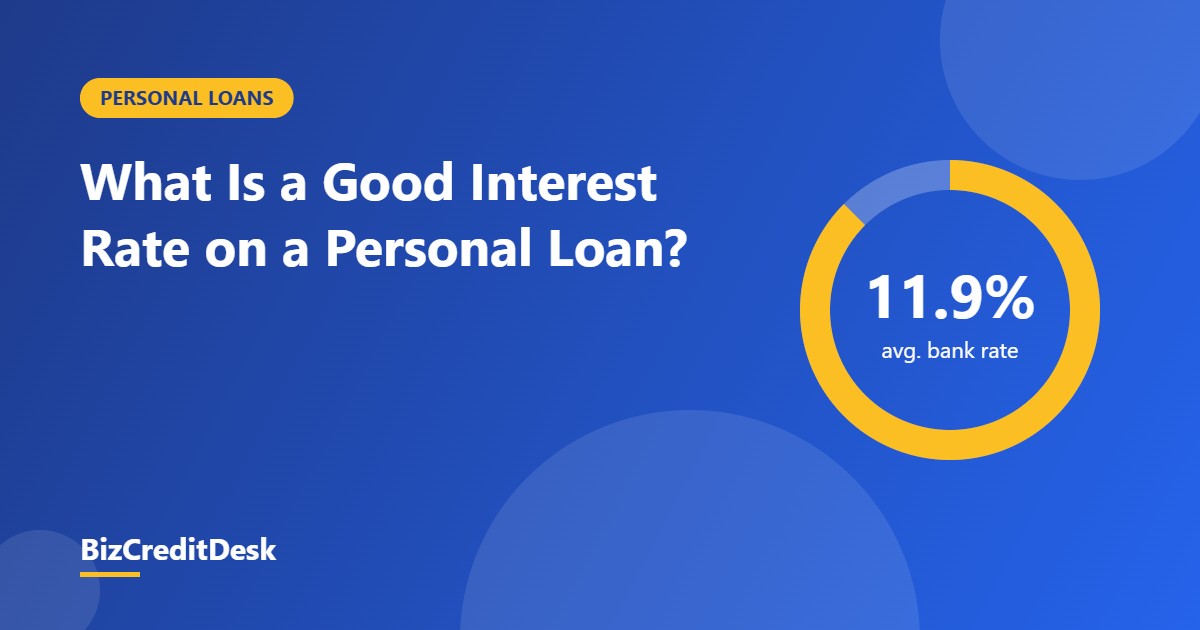
A good way to judge any offer is to compare it with the average. According to the Federal Reserve’s G.19 report, the average rate on a 24-month personal loan at commercial banks was 11.90% in August 2026. For comparison, credit card accounts that were charged interest averaged about 22.36%.
| Your offer | What it means |
|---|---|
| Below 10% | Very good. Usually for borrowers with excellent credit and low debt. |
| 10% to 14% | Around the bank average. A fair, normal offer for good credit. |
| 15% to 24% | Higher than average. Still often cheaper than a credit card. |
| 25% to 36% | Expensive. Common for fair or poor credit. Compare other options first. |
| Above 36% | A red flag. Many consumer advocates consider 36% APR the upper limit for an affordable loan. |
These ranges are a guide, not official categories. Always compare the APR, not just the interest rate, because the APR includes fees such as an origination fee.
What decides the rate you get
- Your credit score. This is the biggest factor. Higher scores get the lowest rates. See what credit score you need for a personal loan.
- Your debt-to-income ratio. Lenders want to know you can afford another payment. Learn how to work out your debt-to-income ratio.
- Income and job stability. A steady income lowers the lender’s risk.
- Loan amount and term. Longer terms often come with higher rates and more total interest.
- Secured or unsecured. Putting up collateral can lower your rate. Compare secured vs. unsecured personal loans.
- The general rate environment. When the Fed raises or cuts rates, loan rates tend to follow. See how Fed rate decisions affect your loans.
Why a “good” rate is about the total cost
Two loans with the same rate can cost very different amounts. Here is a simple example for a $10,000 loan:
| Loan | Monthly payment | Total interest |
|---|---|---|
| 12% APR, 3 years | About $332 | About $1,957 |
| 12% APR, 5 years | About $222 | About $3,347 |
| 20% APR, 3 years | About $372 | About $3,379 |
The longer term has a lower payment but costs much more in total. A good loan is one with a rate you qualify for and a payment you can comfortably make. For the full picture, read how personal loan interest rates work.
How to get a better rate
- Check your credit report first. Fix errors before you apply. Here’s how to read your report and dispute errors.
- Prequalify with several lenders. Prequalification usually uses a soft check, so it doesn’t hurt your score. See hard vs. soft credit inquiries.
- Compare APRs side by side. Use our guide on how to compare personal loan offers.
- Lower your credit utilization. Paying down card balances can raise your score quickly. Read about the 30% utilization rule.
- Consider a co-signer or co-borrower. A partner with strong credit can help. Compare co-signer vs. co-borrower.
- Try a credit union. Federal credit unions are generally limited to an 18% maximum rate on most loans, so their offers can be lower for fair credit.
When a rate is too high
If every offer you get is above about 30%, it may be better to wait, pay down debt and improve your credit before borrowing. Be careful with any lender that guarantees approval or asks for fees upfront. Those are common personal loan scam warning signs.
Key takeaways
- The average 24-month personal loan rate at banks was 11.90% in August 2026, according to the Federal Reserve.
- Below about 10% is very good; 10% to 14% is around average for good credit.
- Compare APRs, not just rates, and look at the total interest over the full term.
- Prequalifying with soft checks lets you shop for the best rate without hurting your score.
Sources
This article is for educational purposes only and is not financial advice. See our Disclaimer.