
Last updated: November 8, 2026
When you shop for a personal loan, one of the first choices is whether to offer collateral. A secured loan is backed by something you own, such as a savings account or a car. An unsecured loan is approved based on your credit and income alone. The difference affects your rate, how easily you get approved and what you stand to lose if things go wrong.
The short version
| Secured personal loan | Unsecured personal loan | |
|---|---|---|
| Collateral | Required (savings, CD, vehicle) | None |
| Typical interest rate | Lower | Higher |
| Approval with fair or bad credit | Easier | Harder |
| If you default | Lender can take the collateral | Collections, damaged credit, possible lawsuit |
| Where to find it | Mostly banks and credit unions | Banks, credit unions, online lenders |
| Speed | Slower (collateral must be verified) | Often funded in days |
How secured loans work
With a secured loan you pledge an asset the lender can claim if you stop paying. Common examples are share-secured or CD-secured loans at credit unions, where your own deposit is frozen as collateral, and loans backed by a vehicle title. Because the lender’s risk is lower, it can offer a lower rate, a larger amount or approval despite a weaker credit history.
The trade-off is real: if you default, you lose the asset. With a vehicle-backed loan, that can mean losing the car you use to get to work.
How unsecured loans work
Most personal loans are unsecured. The lender looks at your credit score, income and existing debts to decide whether to approve you and at what rate. Our guide to how personal loan interest rates work explains how those factors translate into an APR. If you default, the lender can’t seize a specific asset, but it can report the missed payments, send the debt to collections and sue you.
How much the rate difference matters
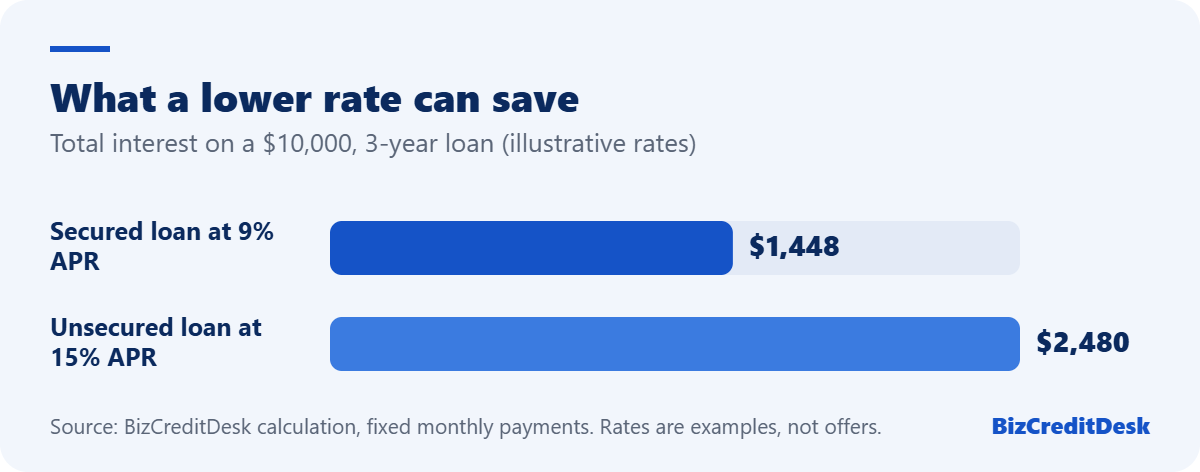
Even a few percentage points add up. In the example below, borrowing $10,000 over three years at 9% instead of 15% saves about $1,032 in interest, and the monthly payment drops from about $347 to $318.
When a secured loan makes sense
- Your credit is fair or poor and unsecured offers are expensive or unavailable. See also how to get a personal loan with bad credit.
- You have savings you don’t want to spend but can pledge, and you want to build credit with a low-cost loan.
- You are confident the payment fits your budget, so the risk to your collateral is low.
When an unsecured loan makes sense
- You have good credit and qualify for a competitive rate without putting anything at risk.
- You don’t have suitable collateral, or the asset is something you can’t afford to lose.
- You need money quickly, for example to consolidate high-interest debt.
Be careful with title loans
Car title loans are a type of secured loan, but they are very different from a credit union auto-secured loan. They are usually short-term, carry triple-digit APRs and can lead to repossession. The Consumer Financial Protection Bureau has found that many title loan borrowers end up rolling the loan over repeatedly. Compare any offer’s APR and total cost before signing.
Key takeaways
- Secured loans use collateral and usually offer lower rates and easier approval.
- Unsecured loans put no asset at risk but depend more heavily on your credit.
- A lower APR can save hundreds or thousands of dollars over the life of a loan.
- Never pledge an asset you can’t afford to lose, and avoid high-cost title loans.